which statements are true about additional information for proving that the triangles are congruent? select…
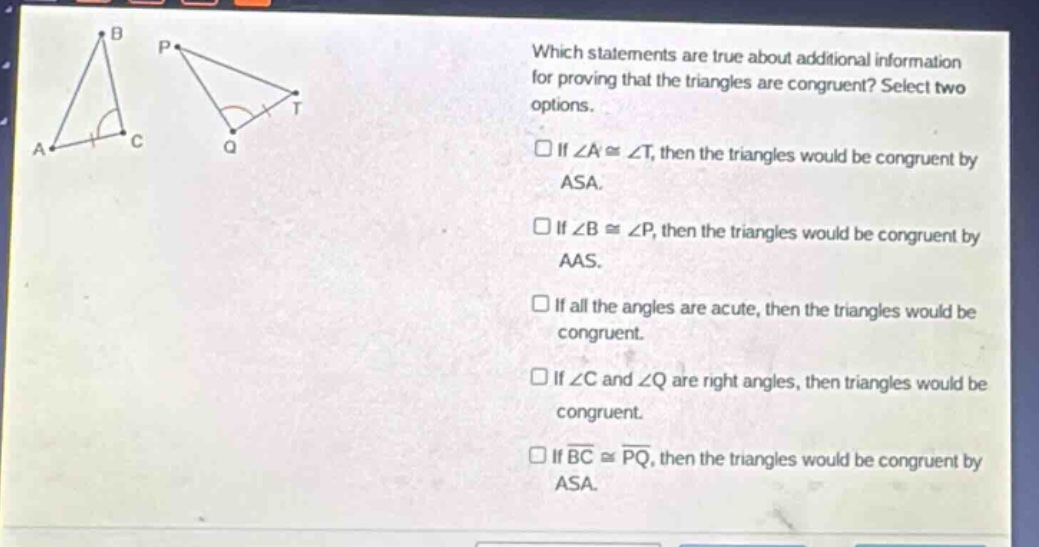
which statements are true about additional information for proving that the triangles are congruent? select two options. if ∠a≅∠t, then the triangles would be congruent by asa. if ∠b≅∠p, then the triangles would be congruent by aas. if all the angles are acute, then the triangles would be congruent. if ∠c and ∠q are right angles, then triangles would be congruent. if bc≅pq, then the triangles would be congruent by asa.
Answer
Explanation:
Step1: Recall congruence postulates
ASA (Angle - Side - Angle) requires two angles and the included side to be congruent. AAS (Angle - Angle - Side) requires two angles and a non - included side to be congruent.
Step2: Analyze each option
- If $\angle A\cong\angle T$, we have two pairs of angles ($\angle A\cong\angle T$ and the marked equal angles) and the included sides are not given as equal, so it's not ASA.
- If $\angle B\cong\angle P$, we have two pairs of angles ($\angle B\cong\angle P$ and the marked equal angles) and a non - included side. So, by AAS, the triangles would be congruent.
- Just knowing all angles are acute is not a congruence postulate, so the triangles won't be congruent just because of this.
- Just knowing $\angle C$ and $\angle Q$ are right angles is not enough to prove congruence without more side or angle information.
- If $\overline{BC}\cong\overline{PQ}$, we have two pairs of angles (the marked equal angles) and the included side, so by ASA, the triangles would be congruent.
Answer:
B. If $\angle B\cong\angle P$, then the triangles would be congruent by AAS. E. If $\overline{BC}\cong\overline{PQ}$, then the triangles would be congruent by ASA.