which statements are true for the functions $g(x)=x^{2}$ and $h(x)=-x^{2}$? check all that apply.\nfor any…
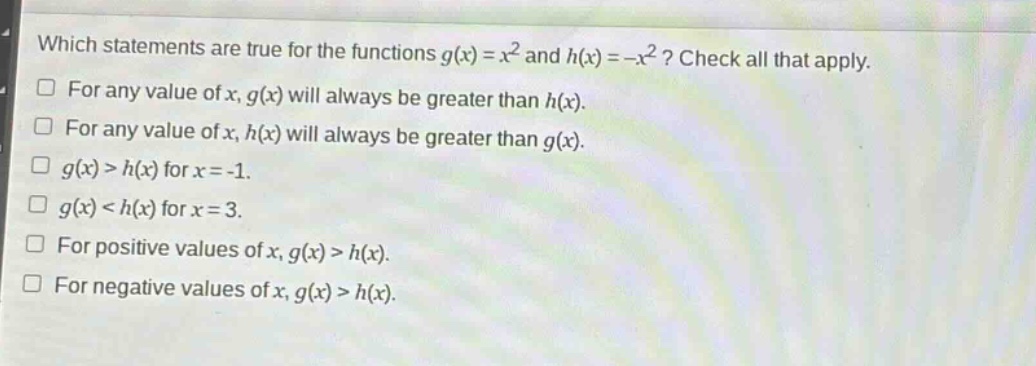
which statements are true for the functions $g(x)=x^{2}$ and $h(x)=-x^{2}$? check all that apply.\nfor any value of $x$, $g(x)$ will always be greater than $h(x)$.\nfor any value of $x$, $h(x)$ will always be greater than $g(x)$.\n$g(x)>h(x)$ for $x = - 1$.\n$g(x)<h(x)$ for $x = 3$.\nfor positive values of $x$, $g(x)>h(x)$.\nfor negative values of $x$, $g(x)>h(x)$.
Answer
Answer:
- For any value of $x$, $g(x)$ will always be greater than $h(x)$.
- $g(x)>h(x)$ for $x = - 1$.
- For positive values of $x$, $g(x)>h(x)$.
- For negative values of $x$, $g(x)>h(x)$.
Explanation:
Step1: Analyze the functions
$g(x)=x^{2}\geq0$ and $h(x)=-x^{2}\leq0$ for all real - valued $x$.
Step2: Check the first statement
Since $g(x)\geq0$ and $h(x)\leq0$ for all $x\in R$, for any value of $x$, $g(x)\geq0$ and $h(x)\leq0$, so $g(x)$ will always be greater than or equal to $h(x)$. When $x\neq0$, $g(x)>h(x)$. So the statement "For any value of $x$, $g(x)$ will always be greater than $h(x)$" is true.
Step3: Check the second statement
As $g(x)\geq0$ and $h(x)\leq0$ for all $x\in R$, $h(x)$ is not always greater than $g(x)$, so this statement is false.
Step4: Check the third statement
When $x = - 1$, $g(-1)=(-1)^{2}=1$ and $h(-1)=-(-1)^{2}=-1$. Since $1>-1$, $g(x)>h(x)$ for $x = - 1$, so this statement is true.
Step5: Check the fourth statement
When $x = 3$, $g(3)=3^{2}=9$ and $h(3)=-3^{2}=-9$. Since $9>-9$, $g(x)>h(x)$ for $x = 3$, so the statement $g(x)<h(x)$ for $x = 3$ is false.
Step6: Check the fifth statement
For positive values of $x$, let $x=a>0$. Then $g(a)=a^{2}>0$ and $h(a)=-a^{2}<0$. So $g(x)>h(x)$ for positive values of $x$, and this statement is true.
Step7: Check the sixth statement
For negative values of $x$, let $x=-a$ where $a>0$. Then $g(-a)=(-a)^{2}=a^{2}>0$ and $h(-a)=-(-a)^{2}=-a^{2}<0$. So $g(x)>h(x)$ for negative values of $x$, and this statement is true.