which statements are true about the linear inequality y > \\frac{3}{4}x - 2? select three options.\nthe…
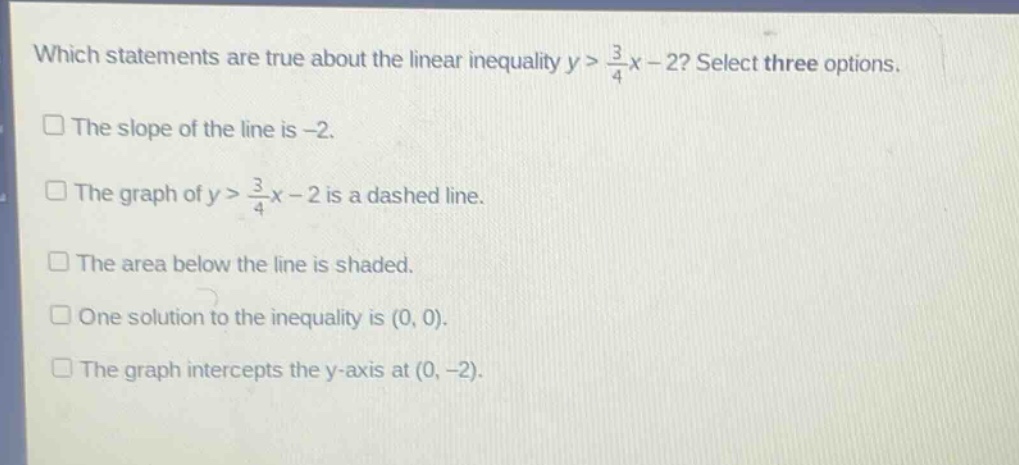
which statements are true about the linear inequality y > \\frac{3}{4}x - 2? select three options.\nthe slope of the line is -2.\nthe graph of y > \\frac{3}{4}x - 2 is a dashed line.\nthe area below the line is shaded.\none solution to the inequality is (0, 0).\nthe graph intercepts the y - axis at (0, -2).
Answer
Explanation:
Step1: Recall slope - intercept form
The linear inequality is in the form $y>mx + b$, where $m$ is the slope and $b$ is the y - intercept. For $y>\frac{3}{4}x - 2$, the slope $m=\frac{3}{4}$ and the y - intercept is at $(0,-2)$. So the statement "The slope of the line is - 2" is false.
Step2: Analyze the type of line
For a strict inequality like $y>mx + b$ (no equal - to sign), the graph of the boundary line $y = mx + b$ is a dashed line. So the statement "The graph of $y>\frac{3}{4}x - 2$ is a dashed line" is true.
Step3: Determine the shaded region
For $y>mx + b$, the area above the line $y=mx + b$ is shaded. So the statement "The area below the line is shaded" is false.
Step4: Check a point
Substitute $x = 0$ and $y = 0$ into the inequality $y>\frac{3}{4}x - 2$. We get $0>\frac{3}{4}(0)-2$, which simplifies to $0>-2$. So the point $(0,0)$ is a solution to the inequality, and the statement "One solution to the inequality is $(0,0)$" is true.
Step5: Find the y - intercept
In the equation $y=\frac{3}{4}x - 2$, when $x = 0$, $y=-2$. So the graph intercepts the y - axis at $(0,-2)$, and the statement "The graph intercepts the y - axis at $(0,-2)$" is true.
Answer:
The graph of $y>\frac{3}{4}x - 2$ is a dashed line; One solution to the inequality is $(0,0)$; The graph intercepts the y - axis at $(0,-2)$.