some of the steps in the derivation of the quadratic formula are shown. step 3: $-c+\frac{b^{2}}{4a}=a(x^{2}+…
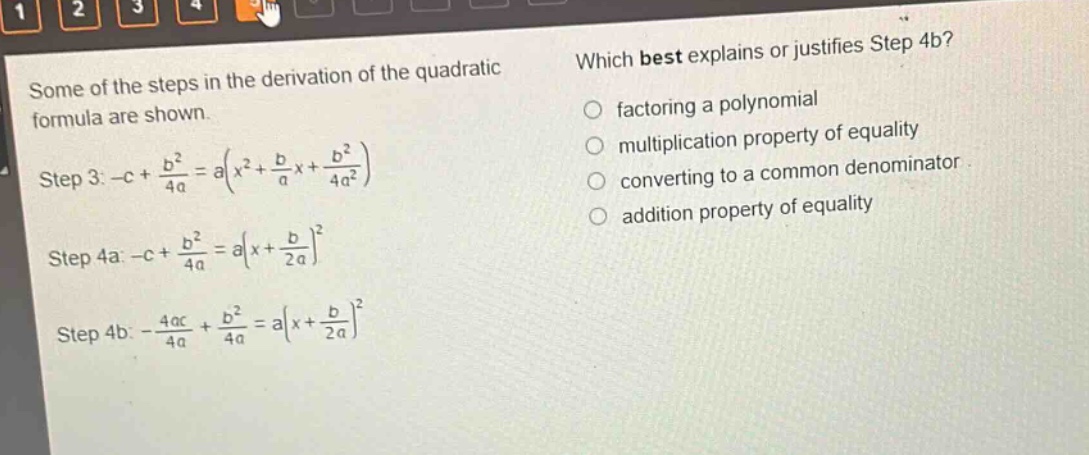
some of the steps in the derivation of the quadratic formula are shown. step 3: $-c+\frac{b^{2}}{4a}=a(x^{2}+\frac{b}{a}x+\frac{b^{2}}{4a^{2}})$ step 4a: $-c+\frac{b^{2}}{4a}=a(x + \frac{b}{2a})^{2}$ step 4b: $-\frac{4ac}{4a}+\frac{b^{2}}{4a}=a(x+\frac{b}{2a})^{2}$ which best explains or justifies step 4b? factoring a polynomial multiplication property of equality converting to a common denominator addition property of equality
Answer
Answer:
converting to a common denominator
Brief Explanations:
In Step 4b, -c is rewritten as $-\frac{4ac}{4a}$ to have a common denominator of $4a$ with $\frac{b^{2}}{4a}$, which is the process of converting to a common denominator.