some of the steps in the derivation of the quadratic formula are shown. step 4: $\frac{-4ac +…
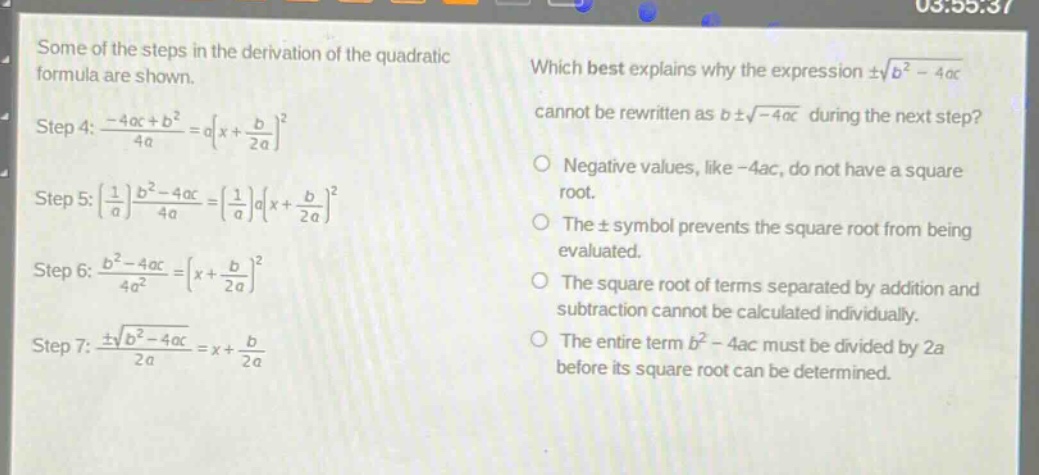
some of the steps in the derivation of the quadratic formula are shown. step 4: $\frac{-4ac + b^{2}}{4a}=a(x+\frac{b}{2a})^{2}$ step 5: $(\frac{1}{a})\frac{b^{2}-4ac}{4a}=(\frac{1}{a})a(x+\frac{b}{2a})^{2}$ step 6: $\frac{b^{2}-4ac}{4a^{2}}=(x+\frac{b}{2a})^{2}$ step 7: $\frac{pmsqrt{b^{2}-4ac}}{2a}=x+\frac{b}{2a}$ which best explains why the expression $pmsqrt{b^{2}-4ac}$ cannot be rewritten as $bpmsqrt{-4ac}$ during the next step? negative values, like -4ac, do not have a square root. the $pm$ symbol prevents the square root from being evaluated. the square root of terms separated by addition and subtraction cannot be calculated individually. the entire term $b^{2}-4ac$ must be divided by 2a before its square root can be determined.
Answer
Brief Explanations:
The square - root property $\sqrt{a + b}\neq\sqrt{a}+\sqrt{b}$ (in general). When taking the square root of $b^{2}-4ac$, we cannot split it into $\sqrt{b^{2}}+\sqrt{- 4ac}$ because the square root of terms separated by addition and subtraction cannot be calculated individually.
Answer:
The square root of terms separated by addition and subtraction cannot be calculated individually.