a student begins to build a model of a downtown bridge in the city where he lives. he measures some of the…
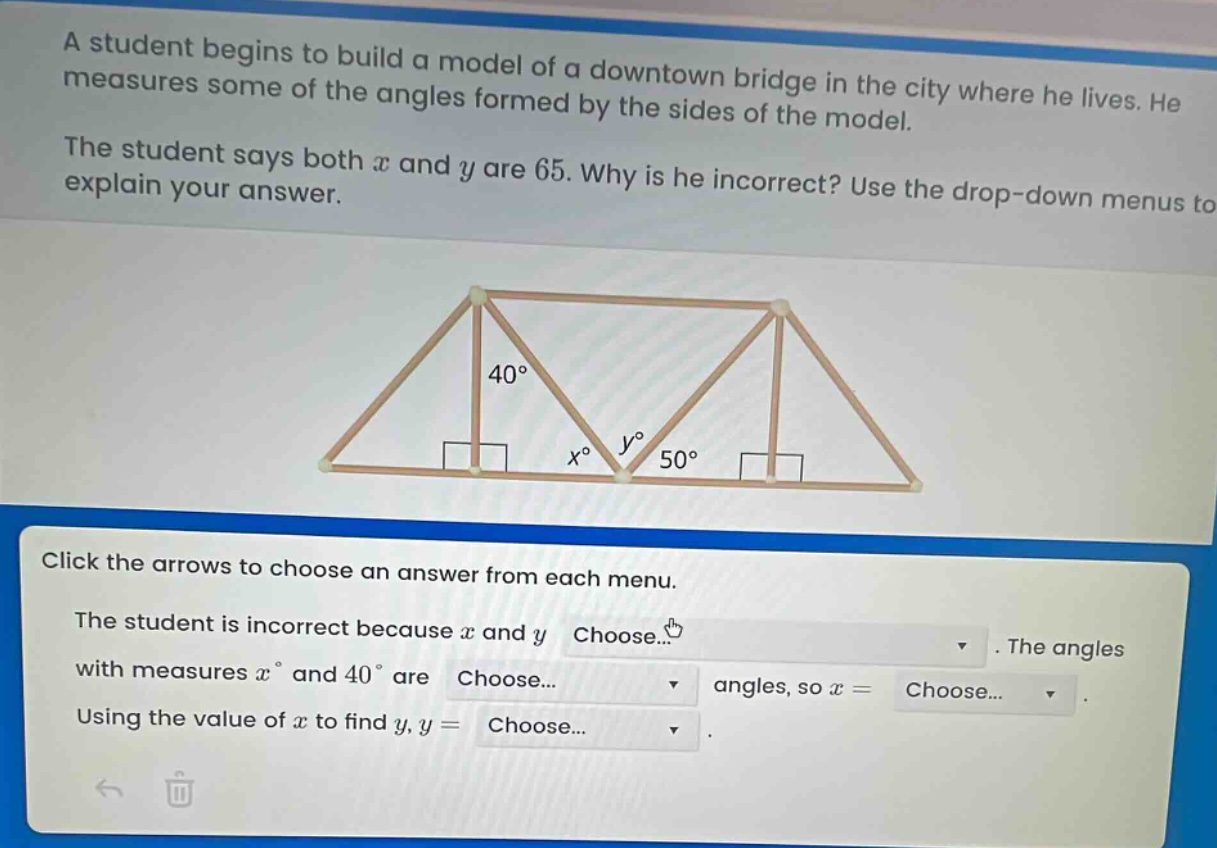
a student begins to build a model of a downtown bridge in the city where he lives. he measures some of the angles formed by the sides of the model. the student says both x and y are 65. why is he incorrect? use the drop - down menus to explain your answer. click the arrows to choose an answer from each menu. the student is incorrect because x and y choose... the angles with measures x° and 40° are choose... angles, so x = choose... using the value of x to find y, y = choose...
Answer
Explanation:
Step1: Identify angle - type relationship for (x)
The angles with measures (x^{\circ}) and (40^{\circ}) are complementary angles (since the vertical support makes a right - angle with the base). Complementary angles add up to (90^{\circ}). So, (x + 40=90).
Step2: Solve for (x)
Subtract (40) from both sides of the equation (x + 40=90). (x=90 - 40=50).
Step3: Solve for (y)
The sum of angles in a triangle is (180^{\circ}). In the triangle with angles (x^{\circ}), (y^{\circ}) and (50^{\circ}), we know (x = 50). So, (x+y + 50=180). Substitute (x = 50) into the equation: (50+y+50 = 180). (y+100=180). Subtract (100) from both sides: (y=180 - 100 = 80).
Answer:
The student is incorrect because (x) and (y) are not equal. The angles with measures (x^{\circ}) and (40^{\circ}) are complementary angles, so (x = 50). Using the value of (x) to find (y), (y = 80).