a student factors 15c² + c - 28 to the following. (c + 2)(15c - 14) which statement about (c + 2)(15c - 14)…
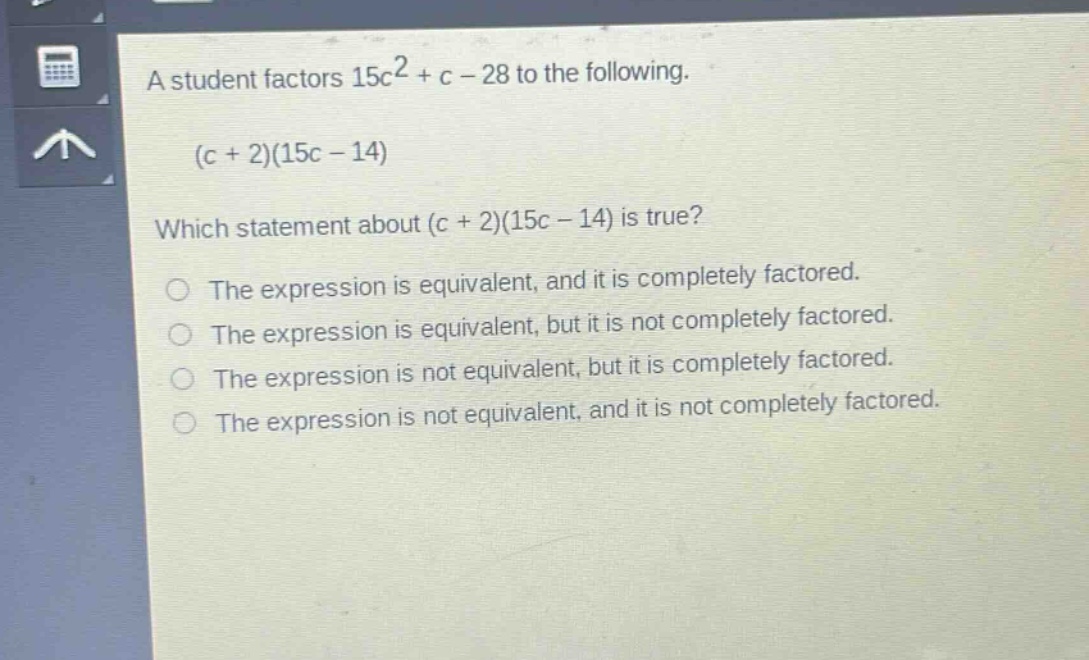
a student factors 15c² + c - 28 to the following. (c + 2)(15c - 14) which statement about (c + 2)(15c - 14) is true? the expression is equivalent, and it is completely factored. the expression is equivalent, but it is not completely factored. the expression is not equivalent, but it is completely factored. the expression is not equivalent, and it is not completely factored.
Answer
Explanation:
Step1: Expand the factored form
[ \begin{align*} (c + 2)(15c-14)&=c\times15c+c\times(-14)+2\times15c + 2\times(-14)\ &=15c^{2}-14c + 30c-28\ &=15c^{2}+16c - 28 \end{align*} ]
Step2: Compare with the original expression
The original expression is (15c^{2}+c - 28), and the expanded form of ((c + 2)(15c - 14)) is (15c^{2}+16c - 28). Since (15c^{2}+16c - 28\neq15c^{2}+c - 28), the two expressions are not equivalent. Also, ((c + 2)(15c - 14)) is in factored - form and there are no common factors within each binomial to further factor. So it is completely factored.
Answer:
The expression is not equivalent, but it is completely factored.