a student factors $a^{6}-64$ to $(a^{2}-4)(a^{4}+4a^{2}+16)$. which statement about $(a^{2}-4)(a^{4}+4a^{2}+1…
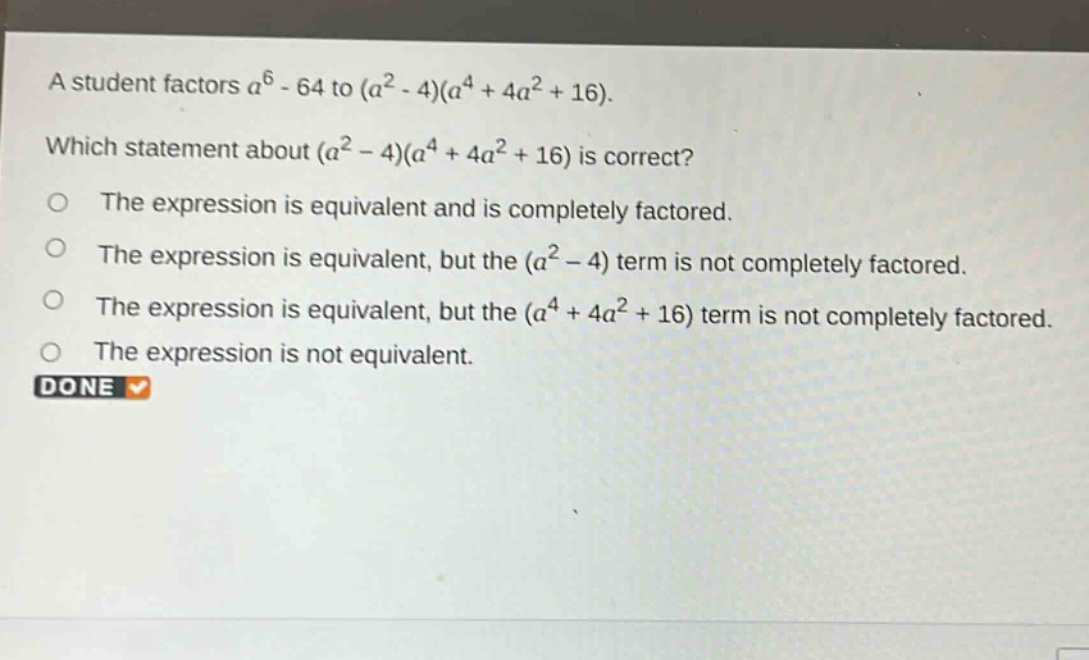
a student factors $a^{6}-64$ to $(a^{2}-4)(a^{4}+4a^{2}+16)$. which statement about $(a^{2}-4)(a^{4}+4a^{2}+16)$ is correct? the expression is equivalent and is completely factored. the expression is equivalent, but the $(a^{2}-4)$ term is not completely factored. the expression is equivalent, but the $(a^{4}+4a^{2}+16)$ term is not completely factored. the expression is not equivalent. done
Answer
Explanation:
Step1: Recall difference - of - squares formula
The difference - of - squares formula is $x^{2}-y^{2}=(x + y)(x - y)$. Here, $a^{2}-4=a^{2}-2^{2}=(a + 2)(a - 2)$.
Step2: Check the equivalence of the factored form
We know that $a^{6}-64=(a^{2})^{3}-4^{3}$. Using the difference - of cubes formula $x^{3}-y^{3}=(x - y)(x^{2}+xy + y^{2})$, where $x = a^{2}$ and $y = 4$, we get $a^{6}-64=(a^{2}-4)(a^{4}+4a^{2}+16)$. But $a^{2}-4$ can be further factored.
Answer:
The expression is equivalent, but the $(a^{2}-4)$ term is not completely factored.