a student solved the equation below by graphing. log₆(x - 1)=log₂(2x + 2) which statement about the graph is…
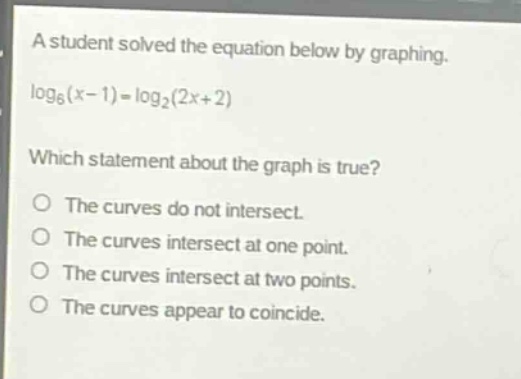
a student solved the equation below by graphing. log₆(x - 1)=log₂(2x + 2) which statement about the graph is true? the curves do not intersect. the curves intersect at one point. the curves intersect at two points. the curves appear to coincide.
Answer
Explanation:
Step1: Recall logarithmic function properties
The domain of $y = \log_{6}(x - 1)$ is $x-1>0$ i.e. $x > 1$, and the domain of $y=\log_{2}(2x + 2)$ is $2x+2>0$ i.e. $x>- 1$. The common - domain for comparing the two functions is $x>1$. The function $y = \log_{6}(x - 1)$ and $y=\log_{2}(2x + 2)$ are both increasing functions. Let's consider their growth rates. The general form of a logarithmic function is $y=\log_{a}u$, and its derivative is $y'=\frac{1}{u\ln a}$. For $y_1=\log_{6}(x - 1)$, $y_1'=\frac{1}{(x - 1)\ln6}$ (for $x>1$). For $y_2=\log_{2}(2x + 2)=\log_{2}2+\log_{2}(x + 1)=1+\log_{2}(x + 1)$, $y_2'=\frac{1}{(x + 1)\ln2}$ (for $x>-1$). As $x$ increases from $x = 1$ (in the common - domain), we can also analyze the functions by considering some values. When $x = 2$: $y_1=\log_{6}(2 - 1)=\log_{6}1=0$ $y_2=\log_{2}(2\times2 + 2)=\log_{2}6> \log_{2}4 = 2$ As $x$ gets larger, the function $y=\log_{2}(2x + 2)$ grows faster than $y=\log_{6}(x - 1)$ because the base of the second logarithm ($a = 2$) is larger than the base of the first logarithm ($a = 6$) and the argument of the second logarithm ($2x + 2$) is larger than the argument of the first logarithm ($x - 1$) for $x>1$. So the two curves do not intersect.
Answer:
The curves do not intersect.