a student solved the equation below by graphing.\nlog₆(x - 1)=log₂(2x + 2)\nwhich statement about the graph…
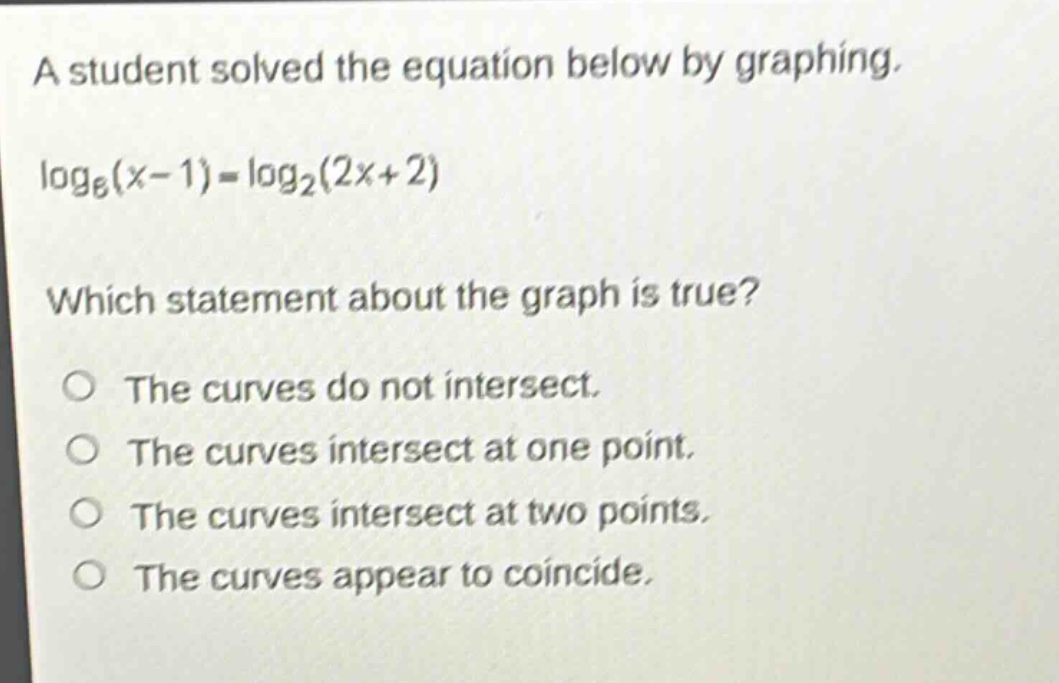
a student solved the equation below by graphing.\nlog₆(x - 1)=log₂(2x + 2)\nwhich statement about the graph is true?\nthe curves do not intersect.\nthe curves intersect at one point.\nthe curves intersect at two points.\nthe curves appear to coincide.
Answer
Explanation:
Step1: Recall the domain of logarithmic functions
For $y = \log_{6}(x - 1)$, the domain is $x-1>0$, i.e., $x > 1$. For $y=\log_{2}(2x + 2)$, the domain is $2x+2>0$, i.e., $x>- 1$. The common - domain for both functions is $x>1$.
Step2: Analyze the growth rate of logarithmic functions
The function $y = \log_{a}x$ with $a>1$ is an increasing function. The base of $y=\log_{6}(x - 1)$ is $a = 6$ and the base of $y=\log_{2}(2x + 2)$ is $a = 2$. Let $f(x)=\log_{6}(x - 1)$ and $g(x)=\log_{2}(2x + 2)$. We know that $\log_{6}(x - 1)=\frac{\ln(x - 1)}{\ln6}$ and $\log_{2}(2x + 2)=\frac{\ln(2x + 2)}{\ln2}$. As $x$ increases from $x = 1$ (in the common - domain), we can consider the behavior of the two functions. The derivative of $y=\log_{6}(x - 1)$ is $y^\prime=\frac{1}{(x - 1)\ln6}$ and the derivative of $y=\log_{2}(2x + 2)$ is $y^\prime=\frac{2}{(2x + 2)\ln2}=\frac{1}{(x + 1)\ln2}$. For $x>1$, we can also analyze the functions by taking some values. When $x = 2$: $f(2)=\log_{6}(2 - 1)=\log_{6}1 = 0$ $g(2)=\log_{2}(2\times2 + 2)=\log_{2}6> \log_{2}4=2$ As $x$ increases, the function $y = \log_{2}(2x + 2)$ grows faster than $y=\log_{6}(x - 1)$ in the common - domain $x>1$. The two curves do not intersect.
Answer:
The curves do not intersect.