a student solves the following equation and determines that the solution is -2. is the student correct…
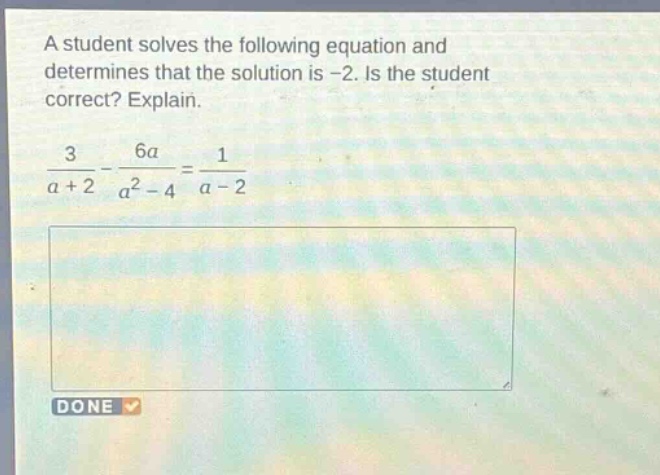
a student solves the following equation and determines that the solution is -2. is the student correct? explain.\n$\frac{3}{a + 2}-\frac{6a}{a^{2}-4}=\frac{1}{a - 2}$
Answer
Answer:
The student is not correct.
Explanation:
Step1: Factor the denominator
$a^{2}-4=(a + 2)(a - 2)$
Step2: Find the common denominator
The common denominator of $\frac{3}{a + 2},\frac{6a}{a^{2}-4},\frac{1}{a - 2}$ is $(a + 2)(a - 2)$.
Step3: Rewrite the fractions with common - denominator
$\frac{3(a - 2)}{(a + 2)(a - 2)}-\frac{6a}{(a + 2)(a - 2)}=\frac{a + 2}{(a + 2)(a - 2)}$
Step4: Simplify the left - hand side
$\frac{3a-6-6a}{(a + 2)(a - 2)}=\frac{a + 2}{(a + 2)(a - 2)}$ $\frac{-3a-6}{(a + 2)(a - 2)}=\frac{a + 2}{(a + 2)(a - 2)}$
Step5: Cross - multiply (since denominators are non - zero for valid solutions)
$-3a-6=a + 2$
Step6: Solve for $a$
$-3a-a=2 + 6$ $-4a=8$ $a=-2$
Step7: Check for extraneous solutions
When $a=-2$, the original denominators $a + 2=0$ and $a^{2}-4 = 0$. So $a=-2$ is an extraneous solution, and the original rational equation has no solution. So the student is not correct.