study this table.\n| x | y |\n| -3 | -2 |\n| -2 | 0 |\n| 0 | 4 |\n| 4 | 12 |\nwhich best describes the…
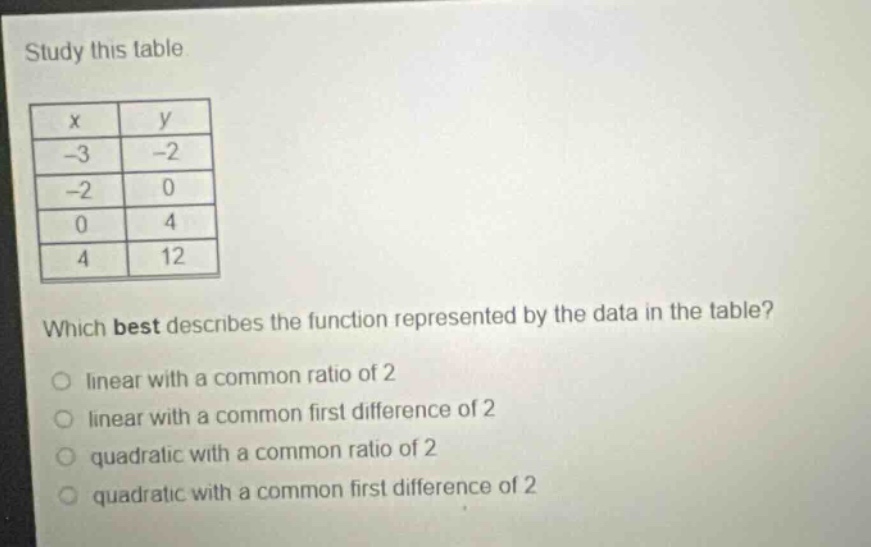
study this table.\n| x | y |\n| -3 | -2 |\n| -2 | 0 |\n| 0 | 4 |\n| 4 | 12 |\nwhich best describes the function represented by the data in the table?\no linear with a common ratio of 2\no linear with a common first difference of 2\no quadratic with a common ratio of 2\no quadratic with a common first difference of 2
Answer
Explanation:
Step1: Calculate first - differences
For $x=-3,y = - 2$; for $x=-2,y = 0$. First - difference of $y$ values: $0-(-2)=2$. For $x=-2,y = 0$; for $x = 0,y = 4$. First - difference of $y$ values: $4 - 0=4$. Since the first - differences are not constant, the function is not linear.
Step2: Check for quadratic nature
A quadratic function has non - constant first - differences. Here, the first - differences are $2,4,\cdots$. We also note that for a linear function, we would have a constant first - difference. And a common ratio is for exponential functions. Since the first - differences are non - constant, it is quadratic and we have found that the first - differences start with 2.
Answer:
quadratic with a common first difference of 2