study the table.\n| x | y |\n| -2 | 8 |\n| -1 | 2 |\n| 0 | 0 |\n| 1 | 2 |\n| 2 | 8 |\nwhich best describes…
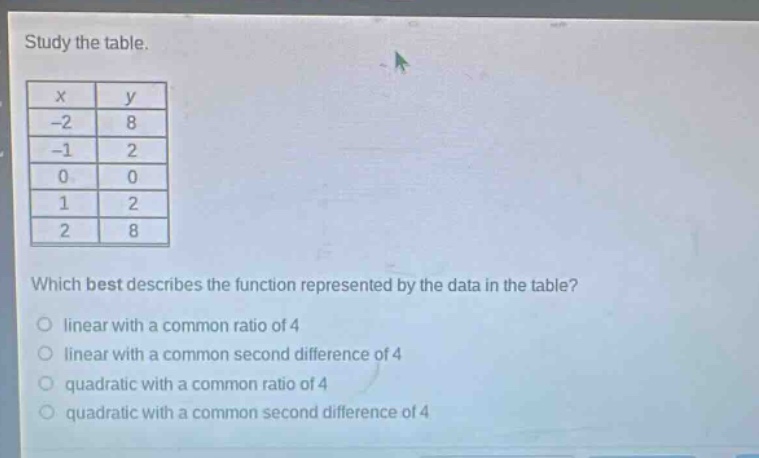
study the table.\n| x | y |\n| -2 | 8 |\n| -1 | 2 |\n| 0 | 0 |\n| 1 | 2 |\n| 2 | 8 |\nwhich best describes the function represented by the data in the table?\no linear with a common ratio of 4\no linear with a common second difference of 4\no quadratic with a common ratio of 4\no quadratic with a common second difference of 4
Answer
Explanation:
Step1: Calculate first - differences
For $x=-2$ to $x = - 1$: $\Delta y_1=2 - 8=-6$; for $x=-1$ to $x = 0$: $\Delta y_2=0 - 2=-2$; for $x = 0$ to $x = 1$: $\Delta y_3=2 - 0=2$; for $x = 1$ to $x = 2$: $\Delta y_4=8 - 2=6$. Since the first - differences are not constant, the function is not linear.
Step2: Calculate second - differences
The first - differences are $-6,-2,2,6$. The second - differences: $\Delta^2y_1=-2-(-6)=4$; $\Delta^2y_2=2-(-2)=4$; $\Delta^2y_3=6 - 2=4$. The common second - difference is 4. A function with a non - zero constant second - difference is quadratic.
Answer:
quadratic with a common second difference of 4