the sum of two complex numbers, where the real numbers do not equal zero, results in a sum of 34i. which…
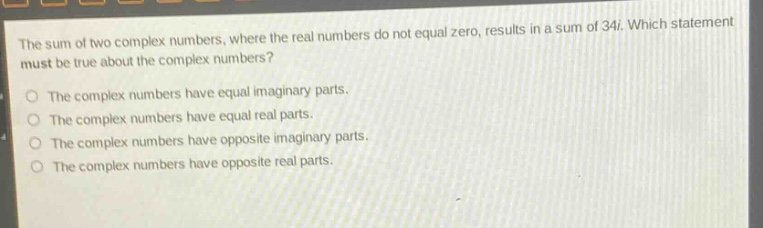
the sum of two complex numbers, where the real numbers do not equal zero, results in a sum of 34i. which statement must be true about the complex numbers?\nthe complex numbers have equal imaginary parts.\nthe complex numbers have equal real parts.\nthe complex numbers have opposite imaginary parts.\nthe complex numbers have opposite real parts.
Answer
Explanation:
Step1: Represent complex numbers
Let the two complex numbers be (a + bi) and (c+di), where (a\neq0), (c\neq0). Their sum is ((a + c)+(b + d)i).
Step2: Analyze the sum
Since the sum is (34i), the real - part (a + c=0) (because there is no real part in (34i)), and the imaginary - part (b + d = 34).
If (a + c=0), then (c=-a).
Answer:
The complex numbers have opposite real parts.