sun, a kayaker, paddles 8 miles upstream (against the current) in 2 hours. returning to her original…
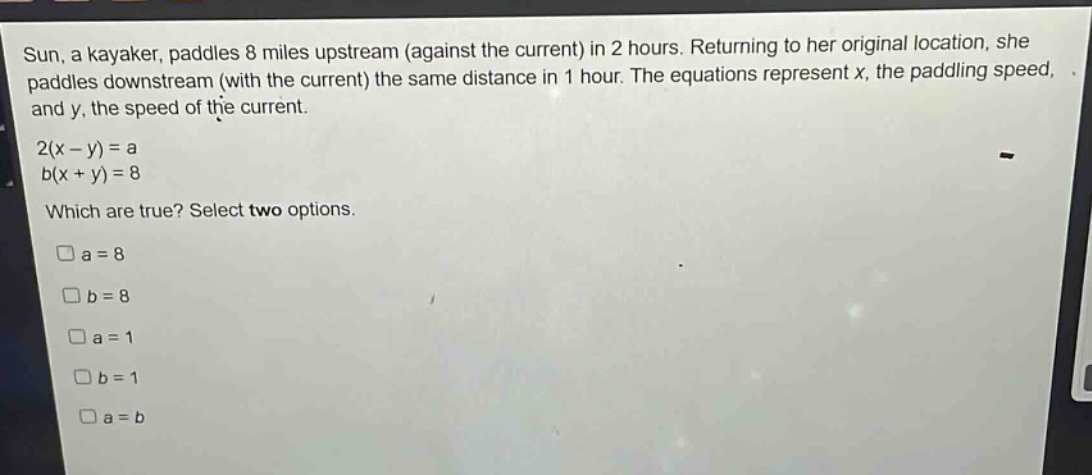
sun, a kayaker, paddles 8 miles upstream (against the current) in 2 hours. returning to her original location, she paddles downstream (with the current) the same distance in 1 hour. the equations represent x, the paddling speed, and y, the speed of the current.\n2(x - y)=a\nb(x + y)=8\nwhich are true? select two options.\n□a = 8\n□b = 8\n□a = 1\n□b = 1\n□a = b
Answer
Explanation:
Step1: Analyze upstream - speed formula
The speed of the kayak upstream is the paddling speed minus the speed of the current, i.e., (v = x - y). The distance (d = 8) miles and time (t = 2) hours. Using the formula (d=v\times t), we have (8 = 2(x - y)), so (a = 8).
Step2: Analyze downstream - speed formula
The speed of the kayak downstream is the paddling speed plus the speed of the current, i.e., (v=x + y). The distance (d = 8) miles and time (t = 1) hour. Using the formula (d = v\times t), we get (8=1\times(x + y)), so (b = 1).
Answer:
A. (a = 8) D. (b = 1)