suppose the first five terms of a sequence are 4, 5, 9, 27, 123. how could the next term in the sequence be…
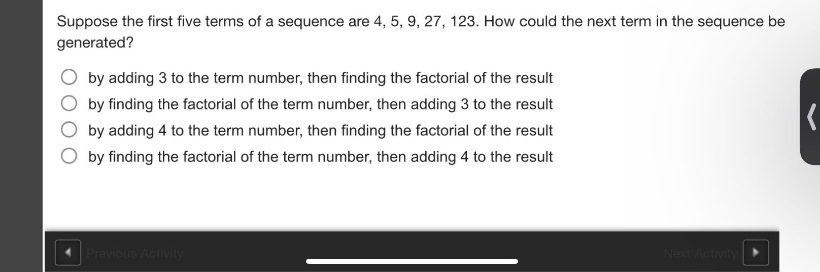
suppose the first five terms of a sequence are 4, 5, 9, 27, 123. how could the next term in the sequence be generated?\nby adding 3 to the term number, then finding the factorial of the result\nby finding the factorial of the term number, then adding 3 to the result\nby adding 4 to the term number, then finding the factorial of the result\nby finding the factorial of the term number, then adding 4 to the result
Answer
Explanation:
Step1: Analyze term - 1
The first - term number is (n = 1). For the first option: ((1 + 3)!=4!=24\neq4). For the second option: (1!+3=1 + 3=4). For the third option: ((1 + 4)!=5!=120\neq4). For the fourth option: (1!+4=1 + 4=5\neq4).
Step2: Analyze term - 2
The second - term number is (n = 2). For the second option: (2!+3=2 + 3=5).
Step3: Analyze term - 3
The third - term number is (n = 3). For the second option: (3!+3=6 + 3=9).
Step4: Analyze term - 4
The fourth - term number is (n = 4). For the second option: (4!+3=24 + 3=27).
Step5: Analyze term - 5
The fifth - term number is (n = 5). For the second option: (5!+3=120 + 3=123).
Answer:
by finding the factorial of the term number, then adding 3 to the result