suppose matrix d is the inverse of matrix c. which of the following is equal to d?\no cdd\no ccd\no ddd\no ccc
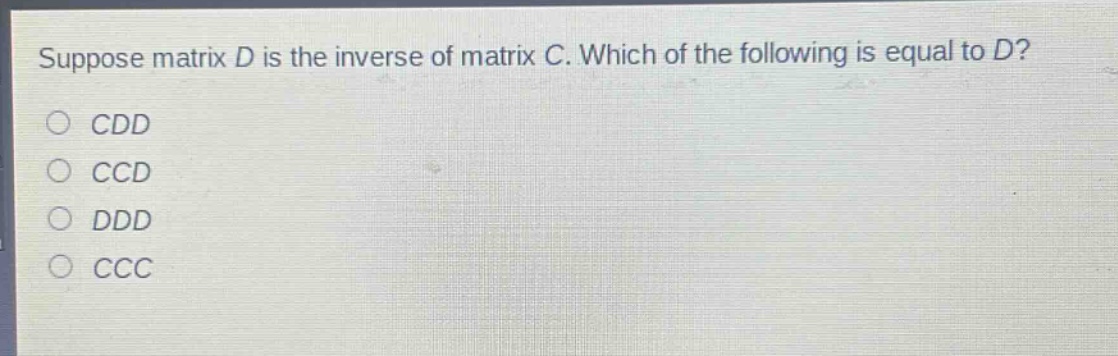
suppose matrix d is the inverse of matrix c. which of the following is equal to d?\no cdd\no ccd\no ddd\no ccc
Answer
Explanation:
Step1: Recall inverse - matrix property
If $D$ is the inverse of $C$, then $CD = DC=I$, where $I$ is the identity matrix.
Step2: Simplify $CDD$
Since $CD = I$, then $CDD=ID$. And by the property of the identity matrix $ID = D$.
Step3: Analyze $CCD$
$CCD=(CC)D$. There is no property that simplifies $(CC)D$ to $D$.
Step4: Analyze $DDD$
$DDD$ is just the product of $D$ with itself three - times and is not equal to $D$.
Step5: Analyze $CCC$
$CCC$ is the product of $C$ with itself three - times and has no relation to $D$.
Answer:
CDD