a system of equations has no solution. if y = 8x + 7 is one of the equations, which could be the other…
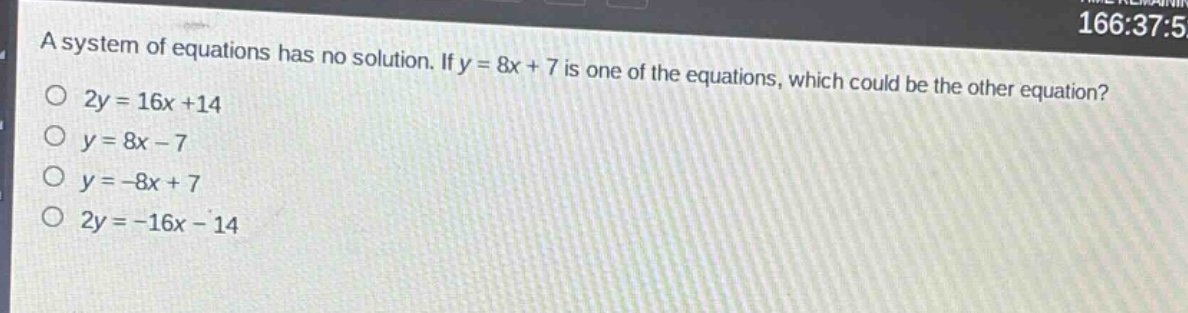
a system of equations has no solution. if y = 8x + 7 is one of the equations, which could be the other equation?\n2y = 16x + 14\n y = 8x - 7\n y = -8x + 7\n2y = -16x - 14
Answer
Explanation:
Step1: Recall parallel - line condition
Two linear equations (y = m_1x + b_1) and (y=m_2x + b_2) have no solution when they are parallel, i.e., (m_1=m_2) and (b_1\neq b_2). The given equation is (y = 8x+7), so (m = 8) and (b = 7).
Step2: Rewrite each option in slope - intercept form (y=mx + b)
- Option 1: (2y=16x + 14), divide by 2 to get (y = 8x+7), same as the given equation (infinite solutions).
- Option 2: (y = 8x-7), (m = 8) and (b=-7), parallel to (y = 8x + 7) (no solution).
- Option 3: (y=-8x + 7), (m=-8\neq8) (intersecting lines, one - solution).
- Option 4: (2y=-16x-14), divide by 2 to get (y=-8x - 7), (m=-8\neq8) (intersecting lines, one - solution).
Answer:
B. (y = 8x - 7)