the system of equations can be solved using linear combination to eliminate one of the variables. 2x - y =…
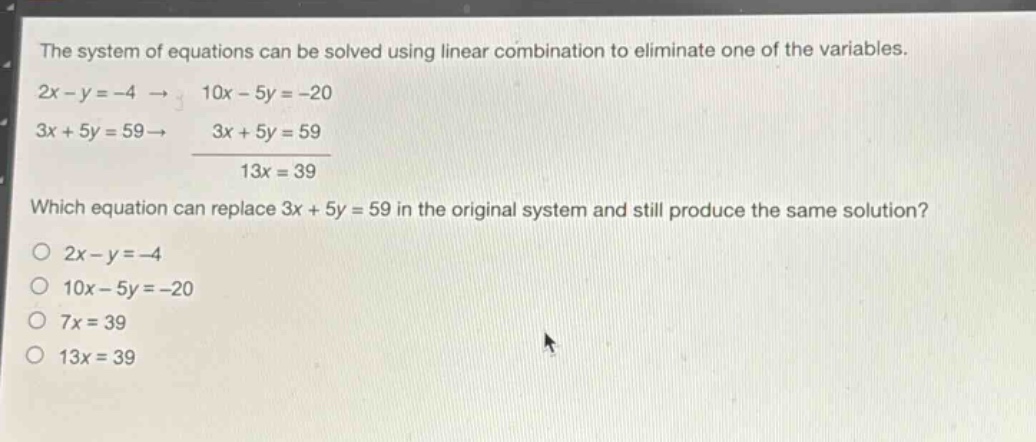
the system of equations can be solved using linear combination to eliminate one of the variables. 2x - y = -4 → 10x - 5y = -20 3x + 5y = 59 → 3x + 5y = 59 13x = 39 which equation can replace 3x + 5y = 59 in the original system and still produce the same solution? 2x - y = -4 10x - 5y = -20 7x = 39 13x = 39
Answer
Explanation:
Step1: Recall the concept of equivalent systems
Two systems of equations are equivalent if they have the same solutions. When we use linear - combination to transform a system, the new equation obtained from combining the original equations can replace one of the original equations in the system without changing the solution set.
Step2: Analyze the given linear - combination
We start with the system of equations: [ \begin{cases} 2x - y=-4\ 3x + 5y = 59 \end{cases} ] We multiply the first equation (2x - y=-4) by (5) to get (10x-5y=-20). Then we add (10x - 5y=-20) and (3x + 5y = 59) together: ((10x-5y)+(3x + 5y)=-20 + 59). Simplifying the left - hand side gives (10x-5y+3x + 5y=13x), and the right - hand side gives (39), so (13x = 39). The equation (13x = 39) is derived from the original system using valid algebraic operations (multiplication and addition of equations). It can replace (3x + 5y = 59) in the original system and still produce the same solution.
Answer:
D. (13x = 39)