a system of inequalities can be used to determine the depth of a toy, in meters, in a pool depending on the…
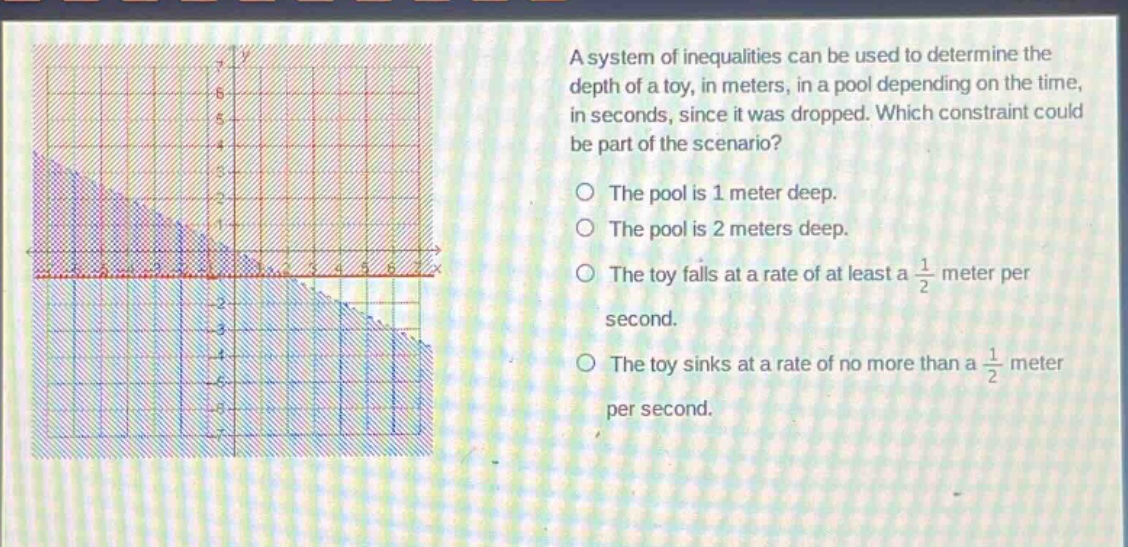
a system of inequalities can be used to determine the depth of a toy, in meters, in a pool depending on the time, in seconds, since it was dropped. which constraint could be part of the scenario?\nthe pool is 1 meter deep.\nthe pool is 2 meters deep.\nthe toy falls at a rate of at least a $\frac{1}{2}$ meter per second.\nthe toy sinks at a rate of no more than a $\frac{1}{2}$ meter per second.
Answer
Explanation:
Step1: Analyze the rate - related constraints
We need to consider the slope - like concept for the rate of the toy's fall. If the toy falls at a rate of at least $\frac{1}{2}$ meter per second, it means the depth $d$ of the toy as a function of time $t$ satisfies $d\geq\frac{1}{2}t$. If it sinks at a rate of no more than $\frac{1}{2}$ meter per second, then $d\leq\frac{1}{2}t$.
Step2: Analyze the depth - related constraints
The depth of the pool is a constant value. But we have no information from the graph about the depth of the pool. However, we can analyze the rate of the toy's fall from the graph's slope - like behavior. If we assume the relationship between depth $d$ and time $t$ is linear (a common assumption for a constant - rate fall), and we consider the general form of a linear inequality $d = rt$ (where $r$ is the rate of fall). A rate of at least $\frac{1}{2}$ meter per second means the toy's depth increases relatively quickly over time.
Answer:
The toy falls at a rate of at least a $\frac{1}{2}$ meter per second.