which system of linear inequalities is represented by the graph?\no (ygeq x - 2) and (yleq x + 1)\no (y<x…
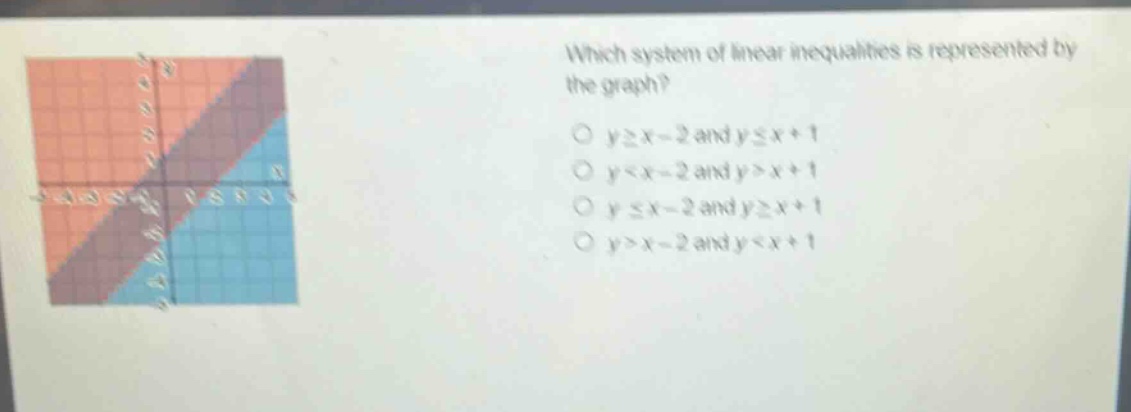
which system of linear inequalities is represented by the graph?\no (ygeq x - 2) and (yleq x + 1)\no (y<x - 2) and (y>x + 1)\no (yleq x - 2) and (ygeq x + 1)\no (y>x - 2) and (y<x + 1)
Answer
Answer:
D. $y>x - 2$ and $y<x + 1$
Explanation:
Step1: Identify the slope - intercept form
The general form of a linear equation is $y=mx + b$, where $m$ is the slope and $b$ is the y - intercept. For the lines $y=x - 2$ and $y=x + 1$, the slope $m = 1$ for both.
Step2: Determine the type of inequalities
The line $y=x - 2$ has a dashed line in the graph, which means the inequality is either $y>x - 2$ or $y<x - 2$. By testing a point (e.g., the origin $(0,0)$), substituting into $y>x - 2$ gives $0>0 - 2$ (true), so one inequality is $y>x - 2$.
Step3: Determine the second inequality
The line $y=x + 1$ also has a dashed line. Testing the origin $(0,0)$ in $y<x + 1$ gives $0<0 + 1$ (true), so the second inequality is $y<x + 1$.