the table represents a bicycle rental cost in dollars as a function of time in hours. which explains whether…
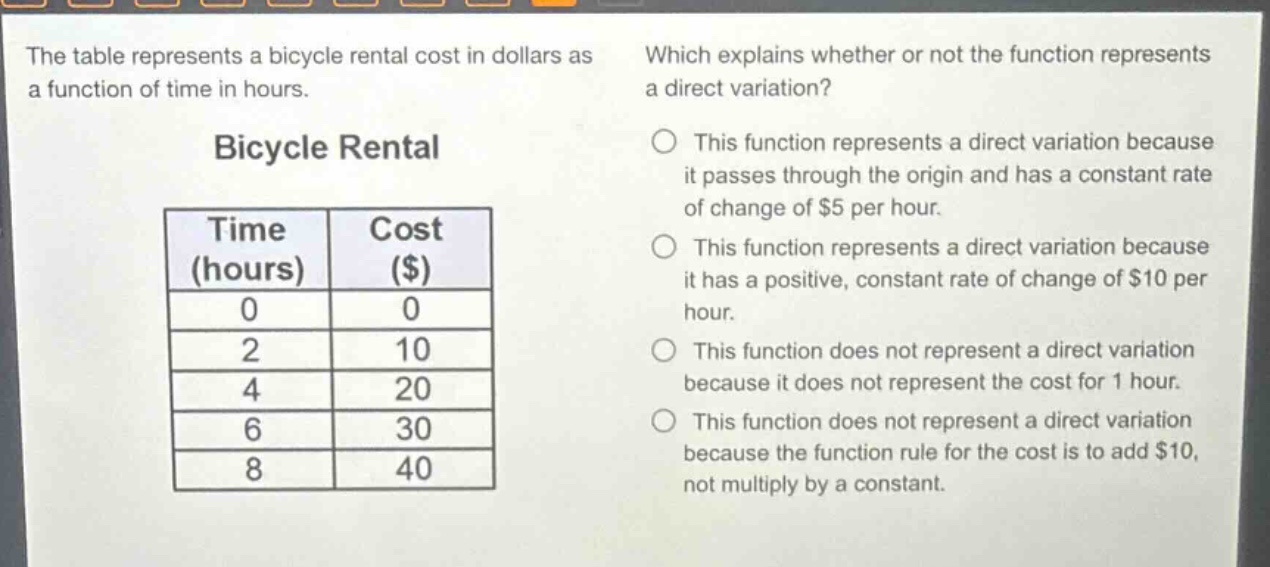
the table represents a bicycle rental cost in dollars as a function of time in hours. which explains whether or not the function represents a direct variation? bicycle rental time (hours) cost ($) 0 0 2 10 4 20 6 30 8 40 this function represents a direct variation because it passes through the origin and has a constant rate of change of $5 per hour. this function represents a direct variation because it has a positive, constant rate of change of $10 per hour. this function does not represent a direct variation because it does not represent the cost for 1 hour. this function does not represent a direct variation because the function rule for the cost is to add $10, not multiply by a constant.
Answer
Explanation:
Step1: Recall direct - variation formula
The formula for direct variation is $y = kx$, where $k$ is the constant of variation, and the graph passes through the origin $(0,0)$.
Step2: Calculate the rate of change
The rate of change (slope) $k=\frac{\Delta y}{\Delta x}$. Using the points $(0,0)$ and $(2,10)$, $k=\frac{10 - 0}{2-0}=\frac{10}{2}=5$. For any two - points $(x_1,y_1)$ and $(x_2,y_2)$ from the table, say $(4,20)$ and $(6,30)$, $k=\frac{30 - 20}{6 - 4}=\frac{10}{2}=5$. The function passes through the origin $(0,0)$ and has a constant rate of change $k = 5$.
Answer:
This function represents a direct variation because it passes through the origin and has a constant rate of change of $5 per hour.