which table represents a direct variation function?\n| x | -3 | -1 | 2 | 5 | 10 |\n| y | -4.5 | -3.0 | -1.5…
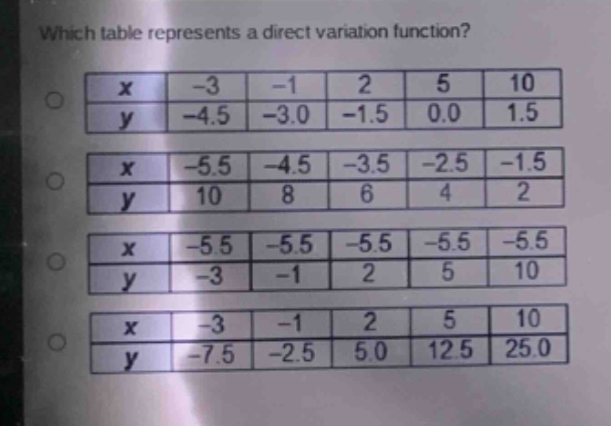
which table represents a direct variation function?\n| x | -3 | -1 | 2 | 5 | 10 |\n| y | -4.5 | -3.0 | -1.5 | 0.0 | 1.5 |\n| x | -5.5 | -4.5 | -3.5 | -2.5 | -1.5 |\n| y | 10 | 8 | 6 | 4 | 2 |\n| x | -5.5 | -5.5 | -5.5 | -5.5 | -5.5 |\n| y | -3 | -1 | 2 | 5 | 10 |\n| x | -3 | -1 | 2 | 5 | 10 |\n| y | -7.5 | -2.5 | 5.0 | 12.5 | 25.0 |
Answer
Explanation:
Step1: Recall direct - variation formula
A direct - variation function has the form $y = kx$, where $k$ is the constant of variation. To check if a table represents a direct - variation function, we calculate $\frac{y}{x}$ for each pair of $(x,y)$ values. If $\frac{y}{x}$ is constant for all pairs, then it is a direct - variation function.
Step2: Check the first table
For the first table: When $x=-3,y = - 4.5$, then $\frac{y}{x}=\frac{-4.5}{-3}=1.5$. When $x=-1,y=-3.0$, then $\frac{y}{x}=\frac{-3.0}{-1}=3$. Since the ratios are not the same, it is not a direct - variation function.
Step3: Check the second table
When $x=-5.5,y = 10$, then $\frac{y}{x}=\frac{10}{-5.5}=-\frac{100}{55}=-\frac{20}{11}$. When $x=-4.5,y = 8$, then $\frac{y}{x}=\frac{8}{-4.5}=-\frac{80}{45}=-\frac{16}{9}$. Since the ratios are not the same, it is not a direct - variation function.
Step4: Check the third table
When $x=-5.5,y=-3$, then $\frac{y}{x}=\frac{-3}{-5.5}=\frac{30}{55}=\frac{6}{11}$. When $x=-5.5,y=-1$, then $\frac{y}{x}=\frac{-1}{-5.5}=\frac{10}{55}=\frac{2}{11}$. Since $x$ is constant ($x=-5.5$) and the ratios $\frac{y}{x}$ are not the same, it is not a direct - variation function.
Step5: Check the fourth table
When $x=-3,y=-7.5$, then $\frac{y}{x}=\frac{-7.5}{-3}=2.5$. When $x=-1,y=-2.5$, then $\frac{y}{x}=\frac{-2.5}{-1}=2.5$. When $x = 2,y = 5.0$, then $\frac{y}{x}=\frac{5.0}{2}=2.5$. When $x = 5,y = 12.5$, then $\frac{y}{x}=\frac{12.5}{5}=2.5$. When $x = 10,y = 25.0$, then $\frac{y}{x}=\frac{25.0}{10}=2.5$. Since $\frac{y}{x}=2.5$ for all pairs of $(x,y)$ values, it is a direct - variation function.
Answer:
The fourth table (with $x$ values $-3,-1,2,5,10$ and $y$ values $-7.5,-2.5,5.0,12.5,25.0$) represents a direct - variation function.