which table represents an exponential function?\n| x | f(x) |\n|----|----|\n| 0 | 1 |\n| 1 | 3 |\n| 2 | 5…
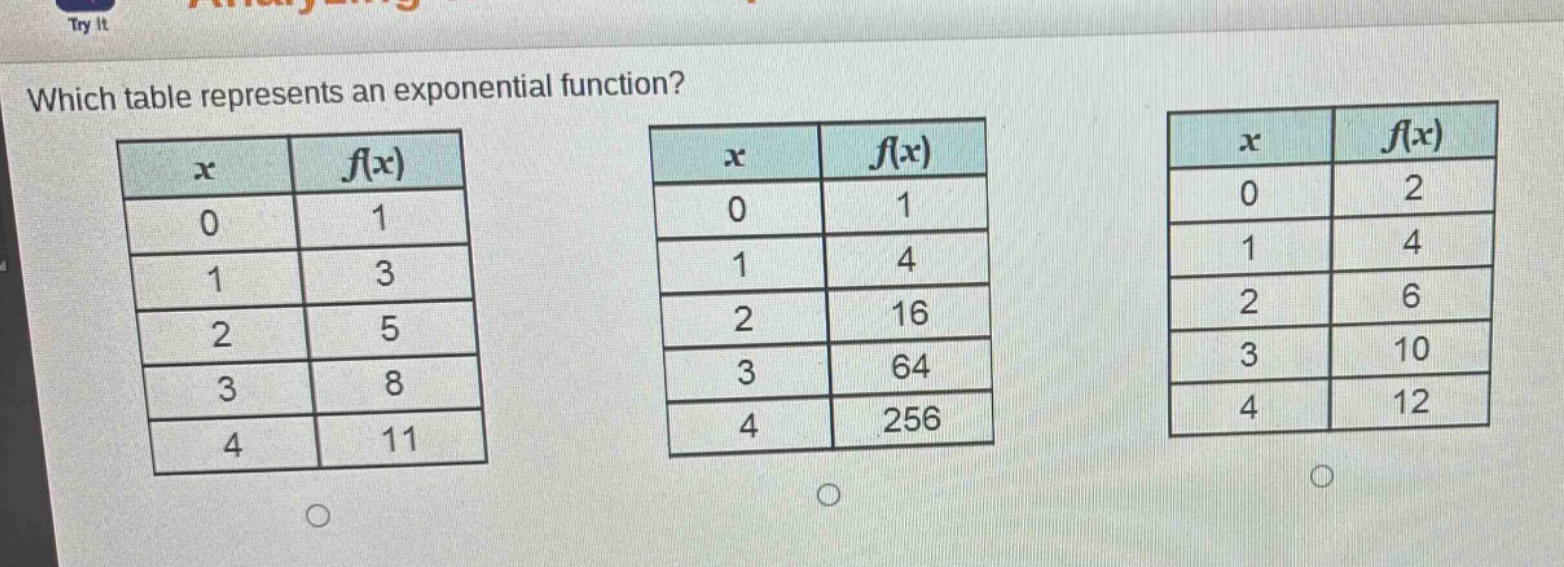
which table represents an exponential function?\n| x | f(x) |\n|----|----|\n| 0 | 1 |\n| 1 | 3 |\n| 2 | 5 |\n| 3 | 8 |\n| 4 | 11 |\n| x | f(x) |\n|----|----|\n| 0 | 1 |\n| 1 | 4 |\n| 2 | 16 |\n| 3 | 64 |\n| 4 | 256 |\n| x | f(x) |\n|----|----|\n| 0 | 2 |\n| 1 | 4 |\n| 2 | 6 |\n| 3 | 10 |\n| 4 | 12 |
Answer
Explanation:
Step1: Recall exponential - function property
An exponential function has a constant ratio between consecutive (y) - values for a constant difference in (x) - values.
Step2: Check first table
For the first table, when (x = 0,f(x)=1); when (x = 1,f(x)=3); when (x = 2,f(x)=5). The differences in (f(x)) are (3 - 1=2), (5 - 3 = 2). It is a linear function (constant difference).
Step3: Check second table
When (x = 0,f(x)=1); when (x = 1,f(x)=4); when (x = 2,f(x)=16); when (x = 3,f(x)=64); when (x = 4,f(x)=256). The ratios are (\frac{4}{1}=4), (\frac{16}{4}=4), (\frac{64}{16}=4), (\frac{256}{64}=4). It is an exponential function of the form (y = a\cdot b^{x}) with (a = 1) and (b = 4).
Step4: Check third table
When (x = 0,f(x)=2); when (x = 1,f(x)=4); when (x = 2,f(x)=6); when (x = 3,f(x)=10); when (x = 4,f(x)=12). There is no constant ratio or constant difference.
Answer:
The second table represents an exponential function.