the table below represents an exponential function.\n| x | y |\n| 0 | 1 |\n| 2 | 49 |\n| 4 | 2,401 |\n| 6 |…
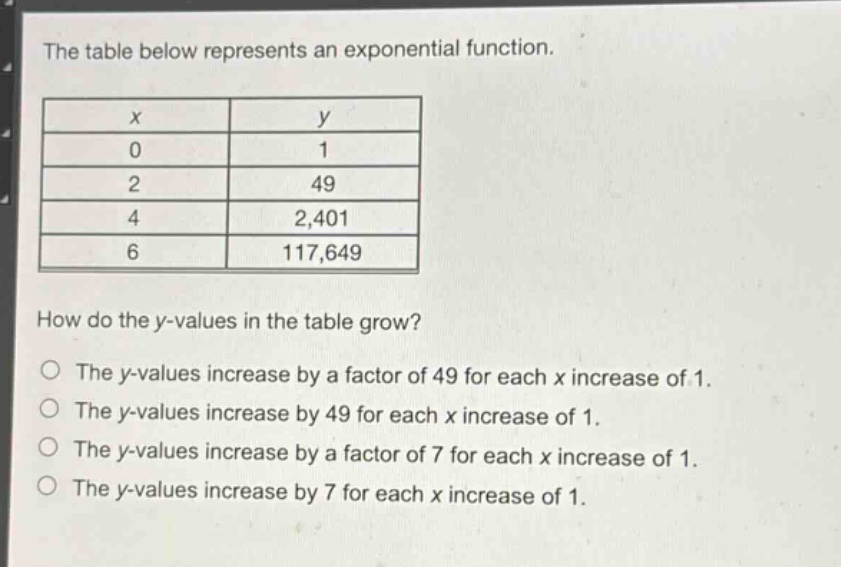
the table below represents an exponential function.\n| x | y |\n| 0 | 1 |\n| 2 | 49 |\n| 4 | 2,401 |\n| 6 | 117,649 |\nhow do the y - values in the table grow?\nthe y - values increase by a factor of 49 for each x increase of 1.\nthe y - values increase by 49 for each x increase of 1.\nthe y - values increase by a factor of 7 for each x increase of 1.\nthe y - values increase by 7 for each x increase of 1.
Answer
Explanation:
Step1: Find the ratio between consecutive y - values
Let's consider the ratio of $y$ - values for different $x$ - intervals. When $x = 0,y = 1$ and when $x=2,y = 49$. The general form of an exponential function is $y=a\cdot b^{x}$. When $x = 0,y=a\cdot b^{0}=a$, so $a = 1$. When $x = 2,y=a\cdot b^{2}$. Since $a = 1$ and $y = 49$ when $x = 2$, we have $b^{2}=49$, so $b=\pm7$. We can also check with other points. When $x = 4,y=a\cdot b^{4}$. Since $a = 1$ and $y = 2401$, and $b^{4}=2401$, taking the fourth - root of 2401 gives $b = 7$ (we take the positive value since exponential growth is usually considered in this context). The ratio of $y$ - values for an increase of $x$ by 1 in an exponential function $y = b^{x}$ is $b$. We know that if we start from $y_1=b^{x_1}$ and go to $y_2=b^{x_1 + 1}$, then $\frac{y_2}{y_1}=\frac{b^{x_1+1}}{b^{x_1}}=b$. Since $b = 7$, for each increase of $x$ by 1, the $y$ - values increase by a factor of 7.
Answer:
The y - values increase by a factor of 7 for each x increase of 1.