which table represents a function?\n| x | y |\n| -3 | -1 |\n| 0 | 0 |\n| -2 | -1 |\n| 8 | 1 |\n| x | y |\n|…
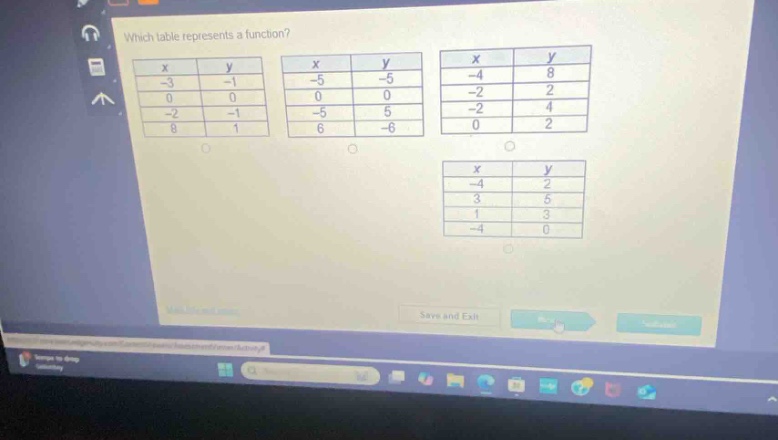
which table represents a function?\n| x | y |\n| -3 | -1 |\n| 0 | 0 |\n| -2 | -1 |\n| 8 | 1 |\n| x | y |\n| -5 | -5 |\n| 0 | 0 |\n| -5 | 5 |\n| 6 | -6 |\n| x | y |\n| -4 | 8 |\n| -2 | 2 |\n| -2 | 4 |\n| 0 | 2 |\n| x | y |\n| -4 | 2 |\n| 3 | 5 |\n| 1 | 3 |\n| -4 | 0 |
Answer
Explanation:
Step1: Recall function definition
A function has one - to - one or many - to - one mapping, i.e., for each input $x$ there is exactly one output $y$.
Step2: Check first table
In the first table, for $x=-3,y = - 1$; for $x = 0,y = 0$; for $x=-2,y=-1$; for $x = 8,y = 1$. Each $x$ has a unique $y$.
Step3: Check second table
In the second table, when $x=-5$, $y=-5$ and $y = 5$. Since one $x$ value ($x=-5$) has two different $y$ values, it is not a function.
Step4: Check third table
In the third table, when $x=-2$, $y = 2$ and $y = 4$. Since one $x$ value ($x=-2$) has two different $y$ values, it is not a function.
Step5: Check fourth table
In the fourth table, when $x=-4$, $y = 2$ and $y = 0$. Since one $x$ value ($x=-4$) has two different $y$ values, it is not a function.
Answer:
The first table represents a function.