table a represents the function that models the stopping distance in feet of a derby car, d(x), based on the…
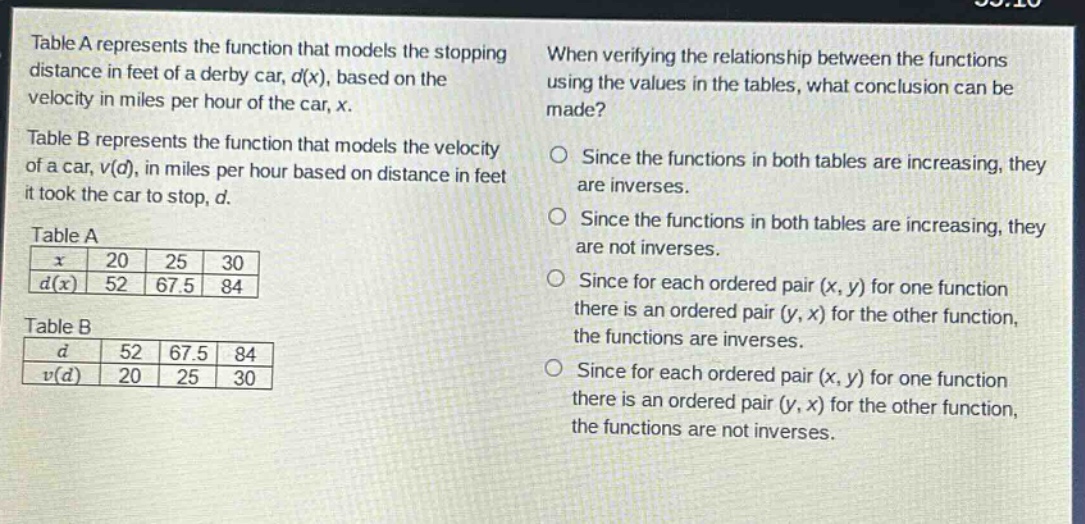
table a represents the function that models the stopping distance in feet of a derby car, d(x), based on the velocity in miles per hour of the car, x. table b represents the function that models the velocity of a car, v(d), in miles per hour based on distance in feet it took the car to stop, d. table a: x 20 25 30; d(x) 52 67.5 84. table b: d 52 67.5 84; v(d) 20 25 30. when verifying the relationship between the functions using the values in the tables, what conclusion can be made? since the functions in both tables are increasing, they are inverses. since the functions in both tables are increasing, they are not inverses. since for each ordered pair (x, y) for one function there is an ordered pair (y, x) for the other function, the functions are inverses. since for each ordered pair (x, y) for one function there is an ordered pair (y, x) for the other function, the functions are not inverses.
Answer
Explanation:
Step1: Recall inverse - function property
Inverse functions have the property that if ((x,y)) is a point on one function, then ((y,x)) is a point on the other function.
Step2: Analyze the given tables
In Table A, we have points ((20,52)), ((25,67.5)), ((30,84)). In Table B, we have points ((52,20)), ((67.5,25)), ((84,30)). For each ordered - pair ((x,y)) in Table A, there is an ordered - pair ((y,x)) in Table B.
Answer:
Since for each ordered pair ((x,y)) for one function there is an ordered pair ((y,x)) for the other function, the functions are inverses.