which table represents a linear function?\n| x | y |\n|----|----|\n| 1 | -2 |\n| 2 | -6 |\n| 3 | -2 |\n| 4 |…
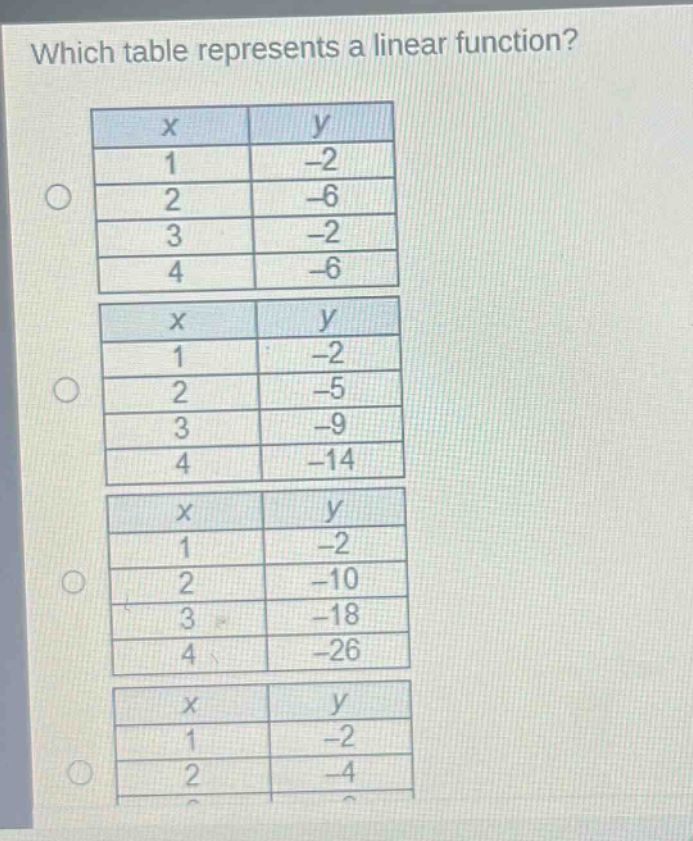
which table represents a linear function?\n| x | y |\n|----|----|\n| 1 | -2 |\n| 2 | -6 |\n| 3 | -2 |\n| 4 | -6 |\n| x | y |\n|----|----|\n| 1 | -2 |\n| 2 | -5 |\n| 3 | -9 |\n| 4 | -14 |\n| x | y |\n|----|----|\n| 1 | -2 |\n| 2 | -10 |\n| 3 | -18 |\n| 4 | -26 |\n| x | y |\n|----|----|\n| 1 | -2 |\n| 2 | -4 |
Answer
Explanation:
Step1: Recall linear - function property
A linear function has a constant rate of change (slope). The slope formula between two points ((x_1,y_1)) and ((x_2,y_2)) is (m=\frac{y_2 - y_1}{x_2 - x_1}).
Step2: Check the first table
For the first table with points ((1,-2)), ((2,-6)), ((3,-2)), ((4,-6)): The slope between ((1,-2)) and ((2,-6)) is (m_1=\frac{-6-(-2)}{2 - 1}=\frac{-6 + 2}{1}=-4). The slope between ((2,-6)) and ((3,-2)) is (m_2=\frac{-2-(-6)}{3 - 2}=\frac{-2 + 6}{1}=4). Since (m_1\neq m_2), it is not a linear function.
Step3: Check the second table
For the second table with points ((1,-2)), ((2,-5)), ((3,-9)), ((4,-14)): The slope between ((1,-2)) and ((2,-5)) is (m_1=\frac{-5-(-2)}{2 - 1}=\frac{-5 + 2}{1}=-3). The slope between ((2,-5)) and ((3,-9)) is (m_2=\frac{-9-(-5)}{3 - 2}=\frac{-9 + 5}{1}=-4). Since (m_1\neq m_2), it is not a linear function.
Step4: Check the third table
For the third table with points ((1,-2)), ((2,-10)), ((3,-18)), ((4,-26)): The slope between ((1,-2)) and ((2,-10)) is (m_1=\frac{-10-(-2)}{2 - 1}=\frac{-10 + 2}{1}=-8). The slope between ((2,-10)) and ((3,-18)) is (m_2=\frac{-18-(-10)}{3 - 2}=\frac{-18 + 10}{1}=-8). The slope between ((3,-18)) and ((4,-26)) is (m_3=\frac{-26-(-18)}{4 - 3}=\frac{-26 + 18}{1}=-8). Since the slope is constant ((m=-8)), it is a linear function.
Step5: Check the fourth table
(Incomplete table in the image, but we already found the correct one).
Answer:
The third table (with (x = 1,y=-2); (x = 2,y=-10); (x = 3,y=-18); (x = 4,y=-26)) represents a linear function.