which table represents a quadratic function?\n| x | f(x) |\n| -4 | -5 |\n| -2 | -2 |\n| 0 | 1 |\n| 2 | 4…
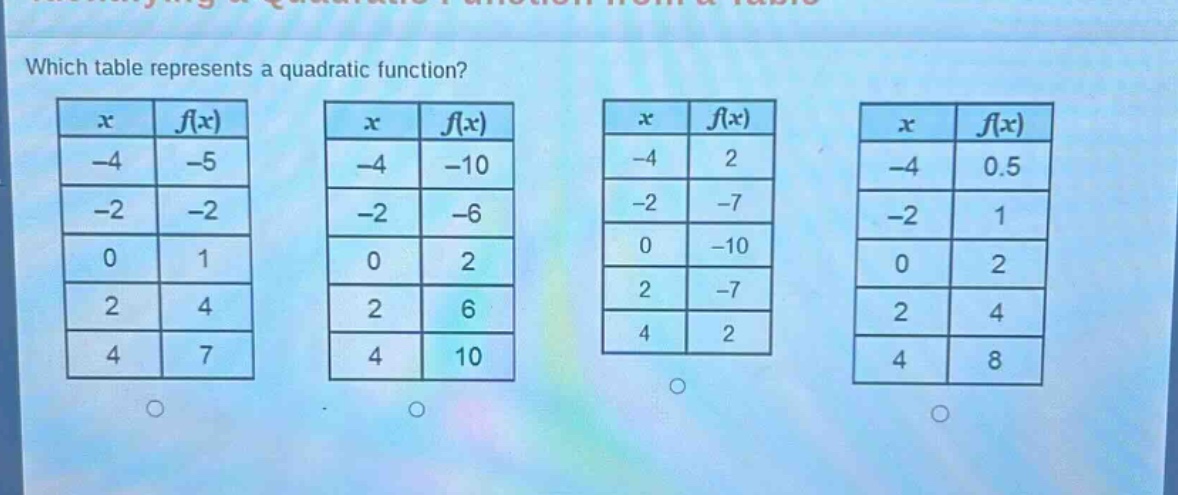
which table represents a quadratic function?\n| x | f(x) |\n| -4 | -5 |\n| -2 | -2 |\n| 0 | 1 |\n| 2 | 4 |\n| 4 | 7 |\n| x | f(x) |\n| -4 | -10 |\n| -2 | -6 |\n| 0 | 2 |\n| 2 | 6 |\n| 4 | 10 |\n| x | f(x) |\n| -4 | 2 |\n| -2 | -7 |\n| 0 | -10 |\n| 2 | -7 |\n| 4 | 2 |\n| x | f(x) |\n| -4 | 0.5 |\n| -2 | 1 |\n| 0 | 2 |\n| 2 | 4 |\n| 4 | 8 |
Answer
Explanation:
Step1: Recall quadratic function property
A quadratic function is symmetric about its vertex. The difference in $x$-values should have a consistent pattern in the $y$-values.
Step2: Check first table
For the first table, the differences in $y$-values for equal - step changes in $x$ do not show a quadratic - like symmetry.
Step3: Check second table
For the second table, the differences in $y$-values for equal - step changes in $x$ do not show a quadratic - like symmetry.
Step4: Check third table
For the third table, when $x=-4$ and $x = 4$, $f(x)=2$; when $x=-2$ and $x = 2$, $f(x)=-7$. The function is symmetric about $x = 0$. The second - differences of the $y$-values for equally - spaced $x$-values are constant for a quadratic function. Let's calculate the first differences: For $x$ changing from $-4$ to $-2$: $f(-2)-f(-4)=-7 - 2=-9$. For $x$ changing from $-2$ to $0$: $f(0)-f(-2)=-10+7=-3$. The second - difference: $(-3)-(-9)=6$. For $x$ changing from $0$ to $2$: $f(2)-f(0)=-7 + 10 = 3$. The second - difference: $3-(-3)=6$. For $x$ changing from $2$ to $4$: $f(4)-f(2)=2 + 7 = 9$. The second - difference: $9 - 3=6$. Since the second - differences are constant, it is a quadratic function.
Step5: Check fourth table
For the fourth table, the differences in $y$-values for equal - step changes in $x$ do not show a quadratic - like symmetry.
Answer:
The third table represents a quadratic function.