this table shows data collected by a runner. which statement about the scenario represented in the table is…
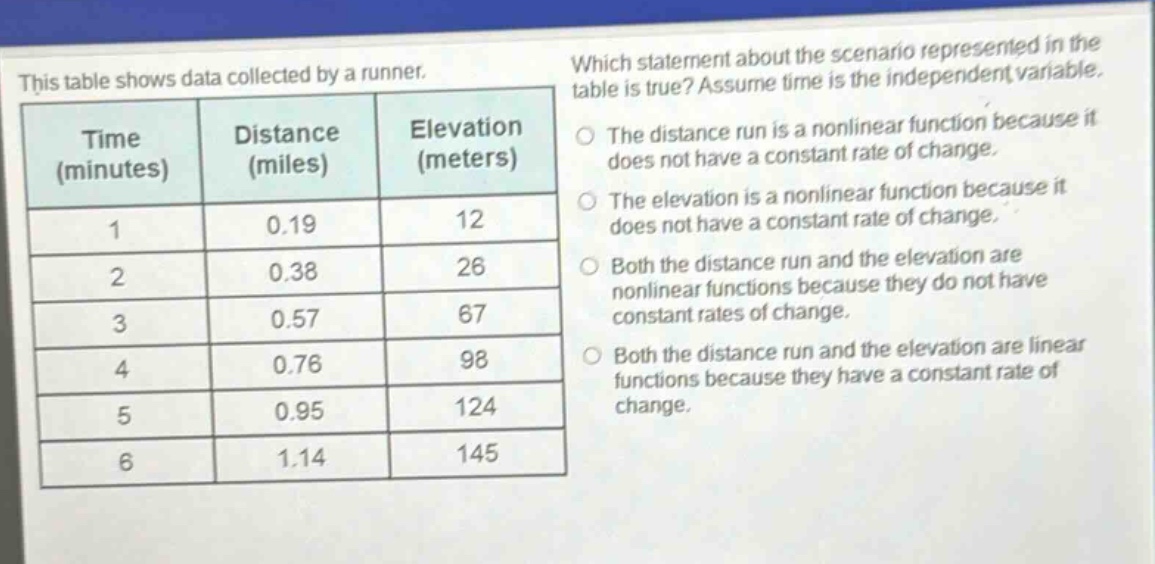
this table shows data collected by a runner. which statement about the scenario represented in the table is true? assume time is the independent variable.\n| time (minutes) | distance (miles) | elevation (meters) |\n| ---- | ---- | ---- |\n| 1 | 0.19 | 12 |\n| 2 | 0.38 | 26 |\n| 3 | 0.57 | 67 |\n| 4 | 0.76 | 98 |\n| 5 | 0.95 | 124 |\n| 6 | 1.14 | 145 |\no the distance run is a nonlinear function because it does not have a constant rate of change.\no the elevation is a nonlinear function because it does not have a constant rate of change.\no both the distance run and the elevation are nonlinear functions because they do not have constant rates of change.\no both the distance run and the elevation are linear functions because they have a constant rate of change.
Answer
Explanation:
Step1: Calculate rate of change for distance
For distance, when time changes from 1 to 2 minutes (change in time $\Delta t=2 - 1=1$ minute), distance changes from 0.19 to 0.38 miles (change in distance $\Delta d = 0.38-0.19 = 0.19$ miles). Rate of change $r_d=\frac{\Delta d}{\Delta t}=\frac{0.38 - 0.19}{2 - 1}=0.19$ miles per minute. Checking for other intervals, for example from 2 to 3 minutes: $\Delta t = 3 - 2=1$ minute, $\Delta d=0.57 - 0.38 = 0.19$ miles, rate is also 0.19 miles per minute. So distance has a constant rate of change.
Step2: Calculate rate of change for elevation
When time changes from 1 to 2 minutes ($\Delta t = 1$ minute), elevation changes from 12 to 26 meters ($\Delta e=26 - 12 = 14$ meters), rate of change $r_{e1}=\frac{26 - 12}{2 - 1}=14$ meters per minute. When time changes from 2 to 3 minutes ($\Delta t = 1$ minute), elevation changes from 26 to 67 meters ($\Delta e=67 - 26 = 41$ meters), rate of change $r_{e2}=\frac{67 - 26}{3 - 2}=41$ meters per minute. Since the rates of change for elevation are not the same, elevation does not have a constant rate of change.
Answer:
The elevation is a nonlinear function because it does not have a constant rate of change.