the table shows how an elevator 500 feet above the ground is descending at a steady rate. which equation…
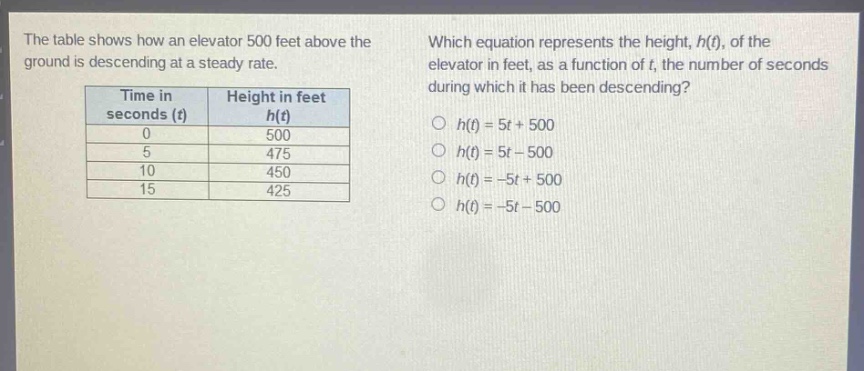
the table shows how an elevator 500 feet above the ground is descending at a steady rate. which equation represents the height, h(t), of the elevator in feet, as a function of t, the number of seconds during which it has been descending?\n| time in seconds (t) | height in feet h(t) |\n| ---- | ---- |\n| 0 | 500 |\n| 5 | 475 |\n| 10 | 450 |\n| 15 | 425 |\n○ h(t)=5t + 500\n○ h(t)=5t - 500\n○ h(t)=-5t + 500\n○ h(t)=-5t - 500
Answer
Explanation:
Step1: Find the rate of change
The elevator starts at 500 feet (when (t = 0), (h(0)=500)). In 5 seconds ((t) changes from 0 to 5), the height changes from 500 to 475 feet. The change in height (\Delta h=475 - 500=- 25) feet and the change in time (\Delta t = 5-0 = 5) seconds. The rate of change (slope (m)) is (\frac{\Delta h}{\Delta t}=\frac{-25}{5}=-5) feet per second.
Step2: Use the slope - intercept form of a linear equation
The slope - intercept form of a linear equation is (h(t)=mt + b), where (m) is the slope and (b) is the (y) - intercept. We know that (m=-5) and when (t = 0), (h(0)=500), so (b = 500). Substituting these values into the equation, we get (h(t)=-5t + 500).
Answer:
(h(t)=-5t + 500)