which table shows a function that is decreasing only over the interval (-1, ∞)?
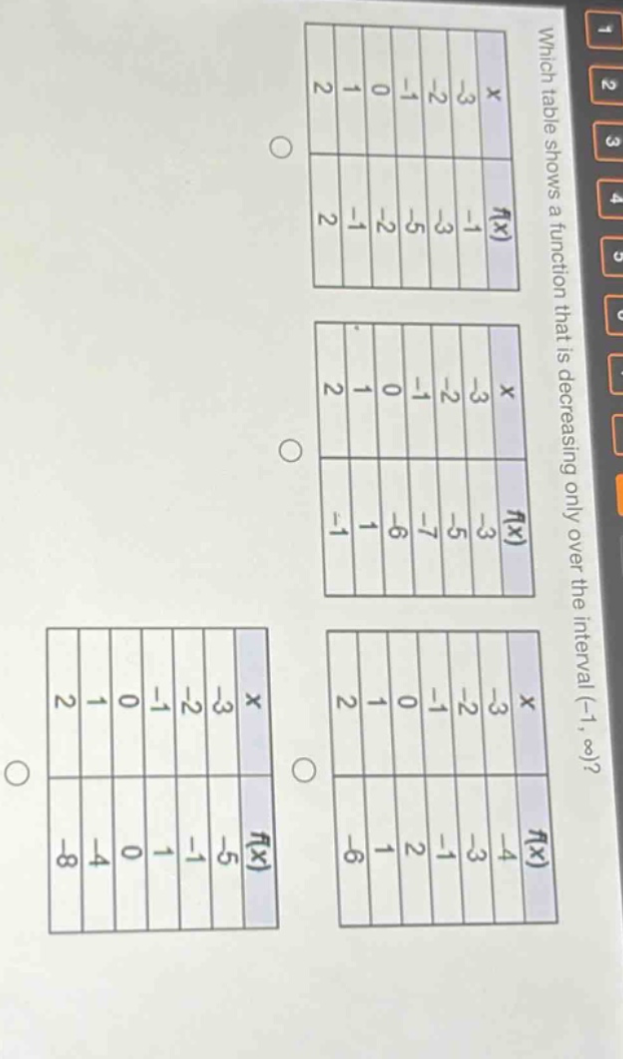
which table shows a function that is decreasing only over the interval (-1, ∞)?
Answer
Answer:
We need to check each table to see if the function is decreasing only over the interval ((- 1,\infty)). For a function (y = f(x)) to be decreasing on an interval, if (x_1<x_2) in the interval, then (f(x_1)>f(x_2)).
Let's analyze each table one - by - one:
Table 1:
| (x) | (f(x)) |
|---|---|
| (2) | (2) |
| (1) | (1) |
| (0) | (0) |
| (-1) | (- 2) |
| (-2) | (-3) |
| (-3) | (x) |
| The function is decreasing for (x> - 1) (since (f(2)>f(1)>f(0)>f(-1))), but it is also decreasing for (x < - 1) ((f(-1)>f(-2))), so this is not the correct table. |
Table 2:
| (x) | (f(x)) |
|---|---|
| (2) | (-1) |
| (1) | (-2) |
| (0) | (-5) |
| (-1) | (-1) |
| (-2) | (-3) |
| The function is decreasing for (x\in(0,1)) and (x\in(1,2)), but (f(-2)<f(-1)), and (f(-1)<f(0)), so it is not decreasing only over ((-1,\infty)) |
Table 3:
| (x) | (f(x)) |
|---|---|
| (2) | (-8) |
| (1) | (-4) |
| (0) | (0) |
| (-1) | (1) |
| (-2) | (-1) |
| (-3) | (-5) |
| For (x < - 1), (f(-3)<f(-2)) and (f(-2)<f(-1)). For (x>-1), (f(0)>f(1)>f(2)). The function is decreasing only for (x > - 1) |
Table 4:
| (x) | (f(x)) |
|---|---|
| (2) | (-6) |
| (1) | (1) |
| (0) | (2) |
| (-1) | (-1) |
| (-2) | (-3) |
| (-3) | (-4) |
| The function is not decreasing for (x\in(0,1)) since (f(0)<f(1)) |
So the table that shows a function that is decreasing only over the interval ((-1,\infty)) is the third table.
Explanation:
Step1: Recall decreasing - function definition
A function (y = f(x)) is decreasing on an interval ((a,b)) if for any (x_1,x_2\in(a,b)) with (x_1 < x_2), (f(x_1)>f(x_2))
Step2: Analyze first table
Check values for (x > - 1) and (x < - 1). It is decreasing for (x < - 1) too, so it's not correct.
Step3: Analyze second table
There are non - decreasing parts for (x < - 1) and inconsistent behavior, so it's not correct.
Step4: Analyze third table
For (x < - 1), the function is non - decreasing and for (x>-1) it is decreasing, so it meets the criteria.
Step5: Analyze fourth table
It has an increasing part for (x\in(0,1)), so it's not correct.