the table shows ordered pairs of the function y = 16 + 0.5x. which ordered pair could be the missing values…
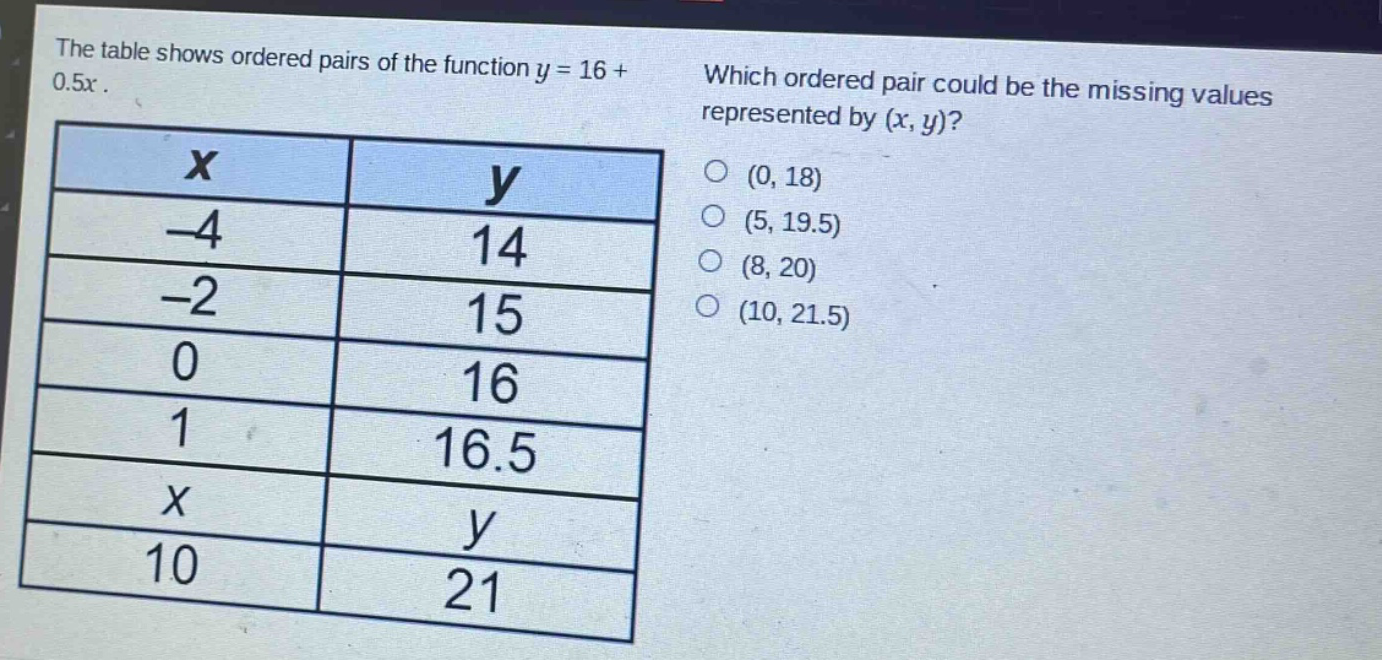
the table shows ordered pairs of the function y = 16 + 0.5x. which ordered pair could be the missing values represented by (x, y)?\n| x | y |\n| -4 | 14 |\n| -2 | 15 |\n| 0 | 16 |\n| 1 | 16.5 |\n| x | y |\n| 10 | 21 |\n(0, 18)\n(5, 19.5)\n(8, 20)\n(10, 21.5)
Answer
Explanation:
Step1: Substitute x - value into function
For each option, substitute the x - value into the function $y = 16+0.5x$. For option A with $x = 0$: $y=16 + 0.5\times0=16\neq18$.
Step2: Check option B
For $x = 5$ in $y = 16+0.5x$, we have $y=16+0.5\times5=16 + 2.5=18.5\neq19.5$.
Step3: Check option C
For $x = 8$ in $y = 16+0.5x$, we get $y=16+0.5\times8=16 + 4=20$.
Step4: Check option D
For $x = 10$ in $y = 16+0.5x$, we have $y=16+0.5\times10=16 + 5=21\neq21.5$.
Answer:
C. (8, 20)