the table shows the total cost of purchasing x same - priced items and a catalog. what is the initial value…
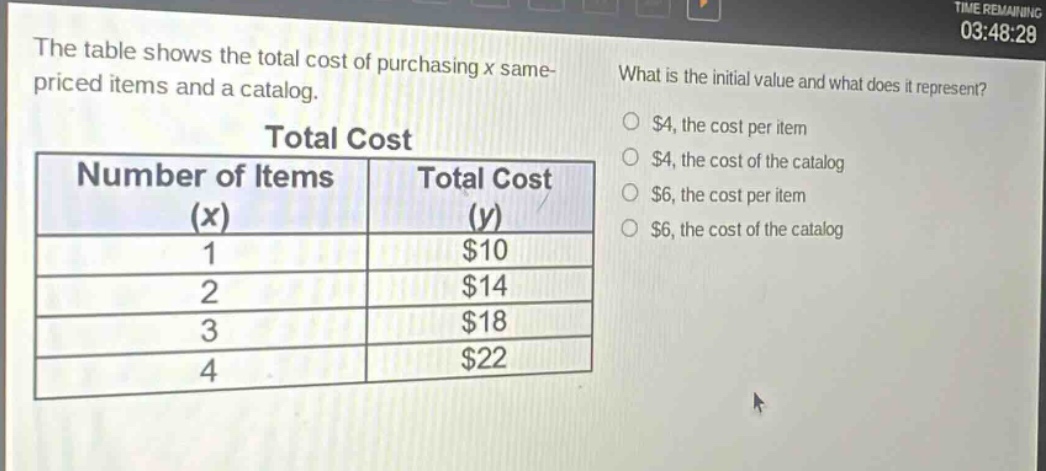
the table shows the total cost of purchasing x same - priced items and a catalog. what is the initial value and what does it represent? total cost\n| number of items (x) | total cost (y) |\n| ---- | ---- |\n| 1 | $10 |\n| 2 | $14 |\n| 3 | $18 |\n| 4 | $22 |\n$4, the cost per item\n$4, the cost of the catalog\n$6, the cost per item\n$6, the cost of the catalog
Answer
Answer:
$6, the cost of the catalog
Explanation:
Step1: Encontrar la ecuación lineal
La ecuación lineal tiene la forma $y = mx + b$, donde $m$ es la pendiente y $b$ es el valor inicial. La pendiente $m=\frac{\Delta y}{\Delta x}$. Tomando dos puntos $(1,10)$ y $(2,14)$: $m=\frac{14 - 10}{2 - 1}=4$. Entonces $y = 4x + b$.
Step2: Calcular el valor inicial $b$
Sustituimos $x = 1$ y $y = 10$ en $y = 4x + b$. Tenemos $10=4\times1 + b$. Resolviendo para $b$: $b=10 - 4=6$. El valor inicial representa el costo fijo, que es el costo del catálogo.