the table can be used to determine the solution of equations, 2x - 2y = 6 and 4x + 4y = 28.\n|original…
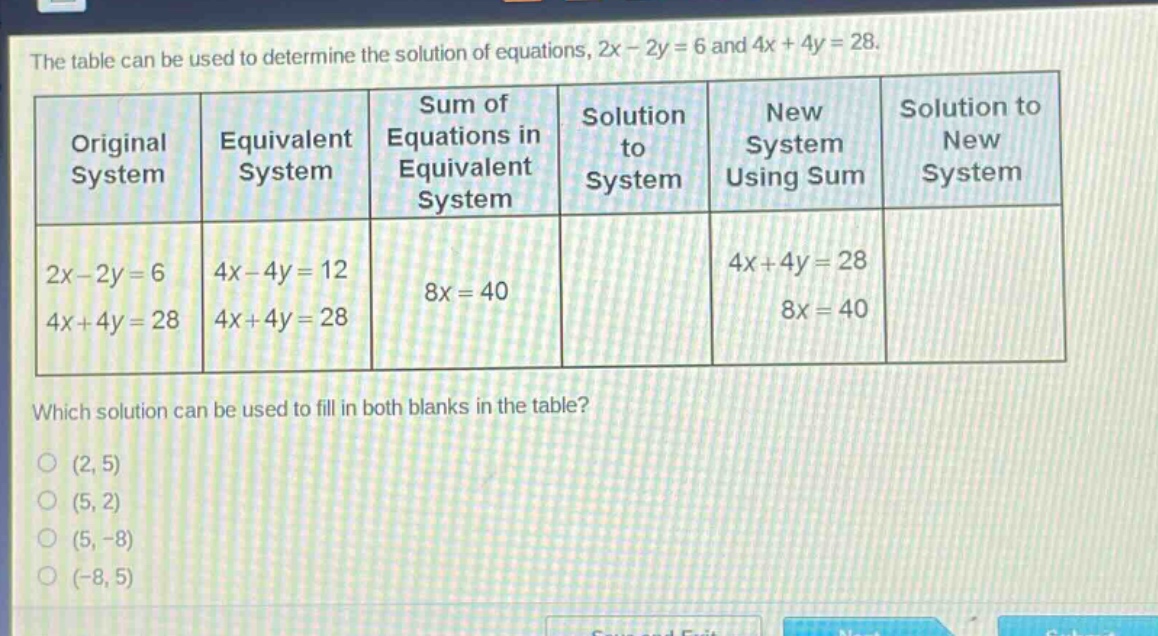
the table can be used to determine the solution of equations, 2x - 2y = 6 and 4x + 4y = 28.\n|original system|equivalent system|sum of equations in equivalent system|solution to system|new system using sum|solution to new system|\n|----|----|----|----|----|----|\n|2x - 2y = 6<br>4x + 4y = 28|4x - 4y = 12<br>4x + 4y = 28|8x = 40| |4x + 4y = 28<br>8x = 40| |\nwhich solution can be used to fill in both blanks in the table?<br>○ (2, 5)<br>○ (5, 2)<br>○ (5, -8)<br>○ (-8, 5)
Answer
Explanation:
Step1: Solve the equation $8x = 40$ for $x$.
Divide both sides by 8: $x=\frac{40}{8}=5$
Step2: Substitute $x = 5$ into the first - original equation $2x−2y = 6$.
$2\times5−2y = 6$, which simplifies to $10−2y = 6$.
Step3: Solve the equation $10−2y = 6$ for $y$.
Subtract 10 from both sides: $-2y=6 - 10=-4$. Then divide both sides by - 2: $y = 2$.
Answer:
B. $(5,2)$