the temperature, t, in degrees fahrenheit, can be found by counting the number of cricket chirps, c, heard…
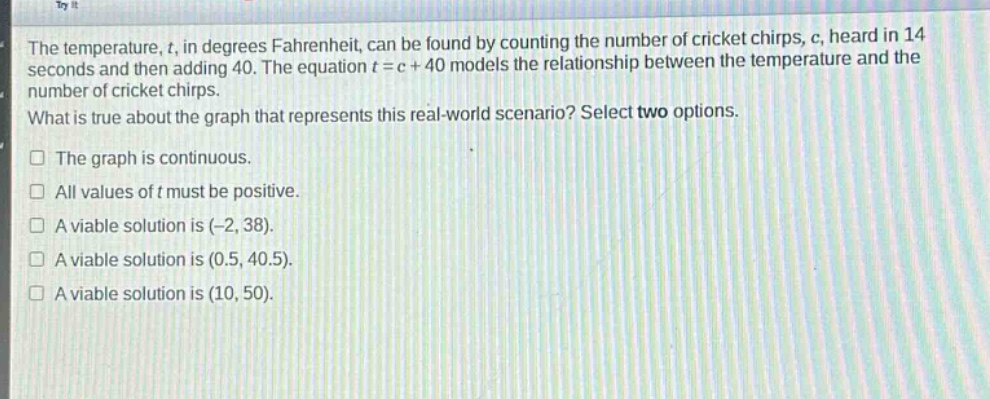
the temperature, t, in degrees fahrenheit, can be found by counting the number of cricket chirps, c, heard in 14 seconds and then adding 40. the equation t = c + 40 models the relationship between the temperature and the number of cricket chirps. what is true about the graph that represents this real - world scenario? select two options. the graph is continuous. all values of t must be positive. a viable solution is (-2, 38). a viable solution is (0.5, 40.5). a viable solution is (10, 50).
Answer
Answer:
- All values of t must be positive.
- A viable solution is (10, 50).
Explanation:
Step1: Analyze graph continuity
The number of cricket - chirps c is a non - negative integer (you can't have a fraction or negative number of chirps). So the graph is discrete, not continuous.
Step2: Analyze t values
Since (t=c + 40) and (c\geq0), then (t\geq40), so all values of t must be positive.
Step3: Analyze solutions
- For the point ((-2,38)): The value of (c=-2) is not possible because the number of chirps cannot be negative.
- For the point ((0.5,40.5)): The number of chirps (c = 0.5) is not possible as the number of chirps must be a whole number.
- For the point ((10,50)): If (c = 10), then (t=c + 40=10 + 40=50), which is a valid solution as (c) is a non - negative integer and (t) is positive.