a tent has the shape of an isosceles triangular prism. the campers add a pole of length b (in feet) for…
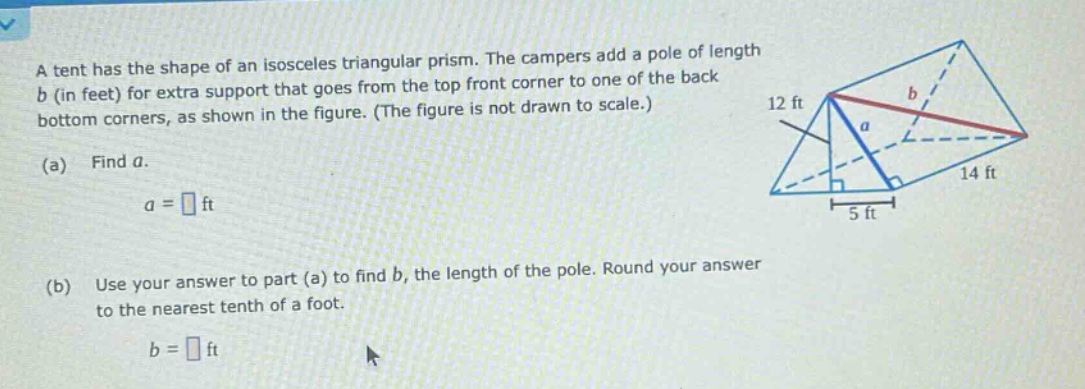
a tent has the shape of an isosceles triangular prism. the campers add a pole of length b (in feet) for extra support that goes from the top front corner to one of the back bottom corners, as shown in the figure. (the figure is not drawn to scale.) (a) find a. a = ft (b) use your answer to part (a) to find b, the length of the pole. round your answer to the nearest tenth of a foot. b = ft
Answer
Explanation:
Step1: Find $a$ using Pythagorean theorem
In the right - triangle with height 12 ft and base 5 ft, by the Pythagorean theorem $a=\sqrt{12^{2}+5^{2}}$. $a=\sqrt{144 + 25}=\sqrt{169}=13$
Step2: Find $b$ using Pythagorean theorem
Now, consider the right - triangle with legs $a = 13$ ft and 14 ft. By the Pythagorean theorem $b=\sqrt{a^{2}+14^{2}}$. Substitute $a = 13$ into the formula: $b=\sqrt{13^{2}+14^{2}}=\sqrt{169+196}=\sqrt{365}\approx19.1$
Answer:
(a) $a = 13$ ft (b) $b\approx19.1$ ft