a theorem in geometry states that the measure of an inscribed angle is half the measure of its intercepted…
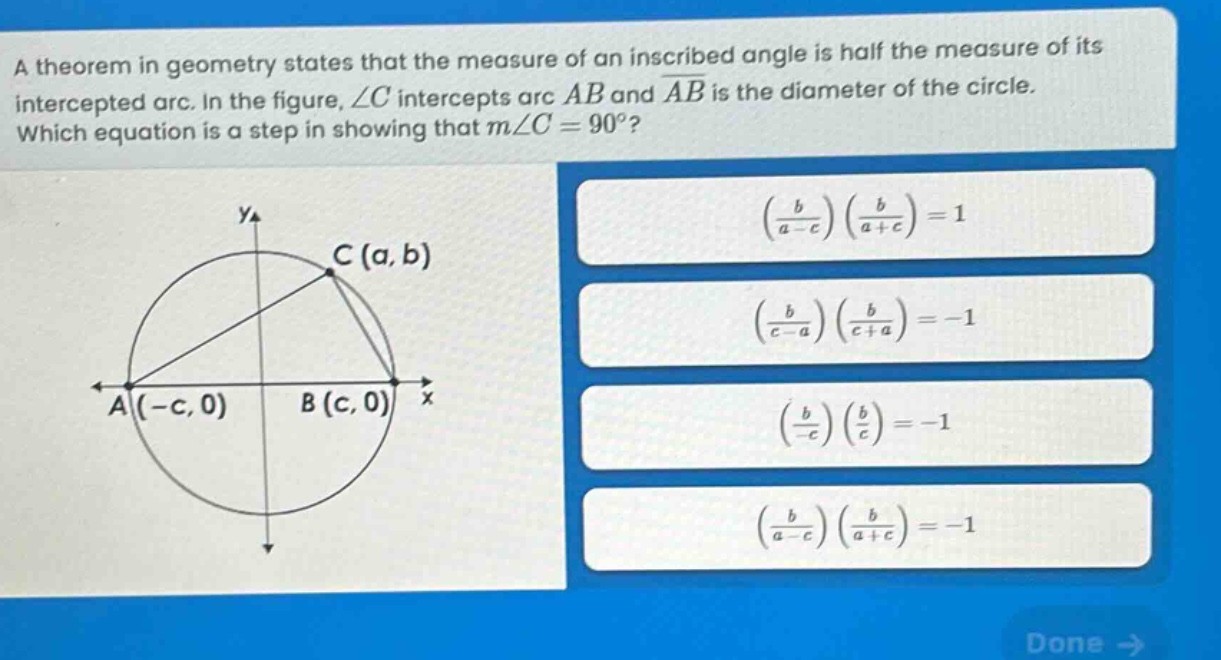
a theorem in geometry states that the measure of an inscribed angle is half the measure of its intercepted arc. in the figure, ∠c intercepts arc ab and (overline{ab}) is the diameter of the circle. which equation is a step in showing that (mangle c = 90^{circ})?
Answer
Explanation:
Step1: Recall slope - formula
The slope of a line passing through two points $(x_1,y_1)$ and $(x_2,y_2)$ is $m=\frac{y_2 - y_1}{x_2 - x_1}$. The slope of line $AC$ with $A(-c,0)$ and $C(a,b)$ is $m_{AC}=\frac{b - 0}{a-(-c)}=\frac{b}{a + c}$. The slope of line $BC$ with $B(c,0)$ and $C(a,b)$ is $m_{BC}=\frac{b-0}{a - c}=\frac{b}{a - c}$.
Step2: Use perpendicular - slope property
If two lines are perpendicular, the product of their slopes is $- 1$. Since $\angle C = 90^{\circ}$, lines $AC$ and $BC$ are perpendicular. So $m_{AC}\times m_{BC}=-1$, which gives $\left(\frac{b}{a + c}\right)\left(\frac{b}{a - c}\right)=-1$.
Answer:
$\left(\frac{b}{a - c}\right)\left(\frac{b}{a + c}\right)=-1$