three points of a function are graphed. which statement describes the function through the points? the…
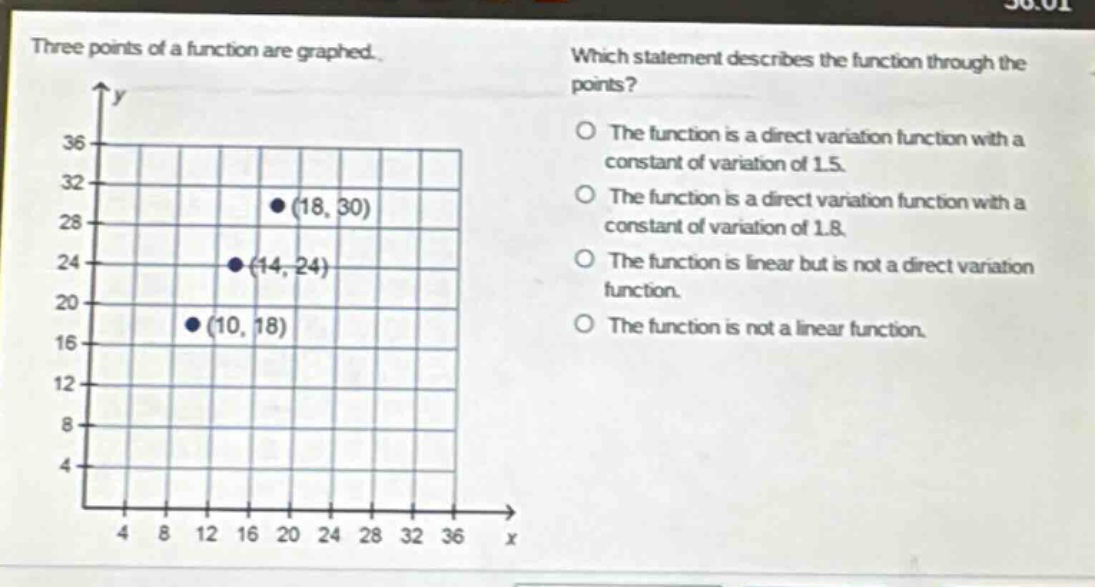
three points of a function are graphed. which statement describes the function through the points? the function is a direct variation function with a constant of variation of 1.5. the function is a direct variation function with a constant of variation of 1.8. the function is linear but is not a direct variation function. the function is not a linear function.
Answer
Explanation:
Step1: Recall direct - variation formula
A direct - variation function has the form $y = kx$, where $k$ is the constant of variation. Calculate $k=\frac{y}{x}$ for each point. For point $(10,18)$: $k_1=\frac{18}{10} = 1.8$. For point $(14,24)$: $k_2=\frac{24}{14}=\frac{12}{7}\approx1.71$. For point $(18,30)$: $k_3=\frac{30}{18}=\frac{5}{3}\approx1.67$. Since $k_1\neq k_2\neq k_3$, it is not a direct - variation function.
Step2: Check if it's linear
The slope between two points $(x_1,y_1)$ and $(x_2,y_2)$ is given by $m=\frac{y_2 - y_1}{x_2 - x_1}$. Slope between $(10,18)$ and $(14,24)$: $m_1=\frac{24 - 18}{14 - 10}=\frac{6}{4}=1.5$. Slope between $(14,24)$ and $(18,30)$: $m_2=\frac{30 - 24}{18 - 14}=\frac{6}{4}=1.5$. Since the slope between any two pairs of points is the same ($m_1 = m_2=1.5$), the function is linear.
Answer:
The function is linear but is not a direct variation function.