three roots of a fifth - degree polynomial function f(x) are -2, 2, and 4 + i. which statement describes the…
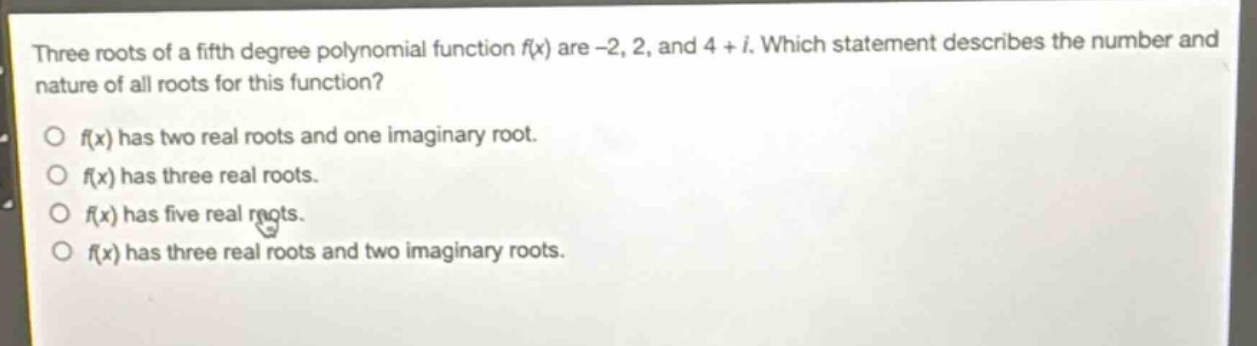
three roots of a fifth - degree polynomial function f(x) are -2, 2, and 4 + i. which statement describes the number and nature of all roots for this function?\no f(x) has two real roots and one imaginary root.\no f(x) has three real roots.\no f(x) has five real roots.\no f(x) has three real roots and two imaginary roots.
Answer
Explanation:
Step1: Recall conjugate root theorem
If a polynomial with real - coefficients has a complex root (a + bi), then its conjugate (a - bi) is also a root. Given (4 + i) is a root, so (4 - i) is also a root of (f(x)).
Step2: Identify real and imaginary roots
The real roots are (-2) and (2). The imaginary roots are (4 + i) and (4 - i). Since it's a fifth - degree polynomial, there must be 5 roots in total. We already have 4 roots ((2) real and (2) imaginary), and the fifth root must be real. So in total, there are 3 real roots ((-2), (2) and the fifth real root) and 2 imaginary roots ((4 + i) and (4 - i)).
Answer:
f(x) has three real roots and two imaginary roots.