toby is buying apples. red delicious apples, x, cost $2 per pound. braeburn apples, y, cost $3 per pound. he…
toby is buying apples. red delicious apples, x, cost $2 per pound. braeburn apples, y, cost $3 per pound. he wants to buy at least 10 pounds of apples, but spend no more than $24. which graph represents this situation?
Answer
Answer:
First, we need to set - up the inequalities based on the problem description:
- Inequality for the total weight of apples:
- Toby wants to buy at least 10 pounds of apples. The total weight of apples is the sum of red - delicious apples (x) (in pounds) and Braeburn apples (y) (in pounds). So, (x + y\geq10). We can rewrite it as (y\geq - x + 10). The boundary line (y=-x + 10) has a (y) - intercept of 10 and a slope of (-1). Since the inequality is (y\geq - x + 10), the region above the line (y=-x + 10) is part of the solution set for this inequality.
- Inequality for the total cost of apples:
- Red - delicious apples cost $2 per pound and Braeburn apples cost $3 per pound, and he wants to spend no more than $24. So, (2x+3y\leq24). We can rewrite it in slope - intercept form:
- (3y\leq - 2x + 24), then (y\leq-\frac{2}{3}x + 8). The boundary line (y =-\frac{2}{3}x+8) has a (y) - intercept of 8 and a slope of (-\frac{2}{3}). Since the inequality is (y\leq-\frac{2}{3}x + 8), the region below the line (y=-\frac{2}{3}x + 8) is part of the solution set for this inequality.
- Also, (x\geq0) and (y\geq0) because the number of pounds of apples cannot be negative.
- To find the intersection of (y=-x + 10) and (y=-\frac{2}{3}x + 8):
- Set (-x + 10=-\frac{2}{3}x + 8).
- Add (x) to both sides: (10=-\frac{2}{3}x+x + 8).
- Combine like terms: (10=\frac{1}{3}x + 8).
- Subtract 8 from both sides: (2=\frac{1}{3}x).
- Multiply both sides by 3: (x = 6).
- Substitute (x = 6) into (y=-x + 10), we get (y=-6 + 10=4). The intersection point of (y=-x + 10) and (y=-\frac{2}{3}x + 8) is ((6,4)).
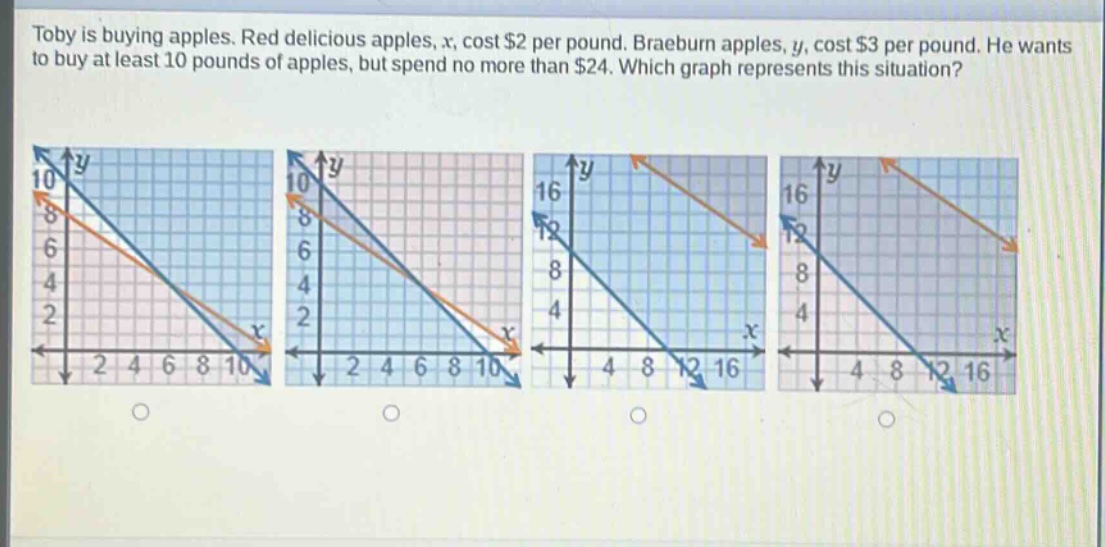
- Analyzing the graphs:
- The first graph has the line (y=-x + 10) with the region below it (wrong for (x + y\geq10)) and (y=-\frac{2}{3}x + 8) with the region above it (wrong for (2x + 3y\leq24)).
- The second graph has (y=-x + 10) with the region above it and (y=-\frac{2}{3}x + 8) with the region below it, which is correct.
- The third and fourth graphs have incorrect (y) - intercepts for the lines (the (y) - intercept of (y=-x + 10) should be 10 and for (y=-\frac{2}{3}x + 8) should be 8). So the correct graph is the second one.
- Red - delicious apples cost $2 per pound and Braeburn apples cost $3 per pound, and he wants to spend no more than $24. So, (2x+3y\leq24). We can rewrite it in slope - intercept form:
Explanation:
Step1: Set up weight inequality
(x + y\geq10\Rightarrow y\geq - x + 10)
Step2: Set up cost inequality
(2x+3y\leq24\Rightarrow y\leq-\frac{2}{3}x + 8)
Step3: Find intersection point
Set (-x + 10=-\frac{2}{3}x + 8), solve for (x) and (y)
Step4: Analyze graphs
Check regions and intercepts of lines in each graph.