todays technology can store audio files so that scholars of the future can listen to music from the past…
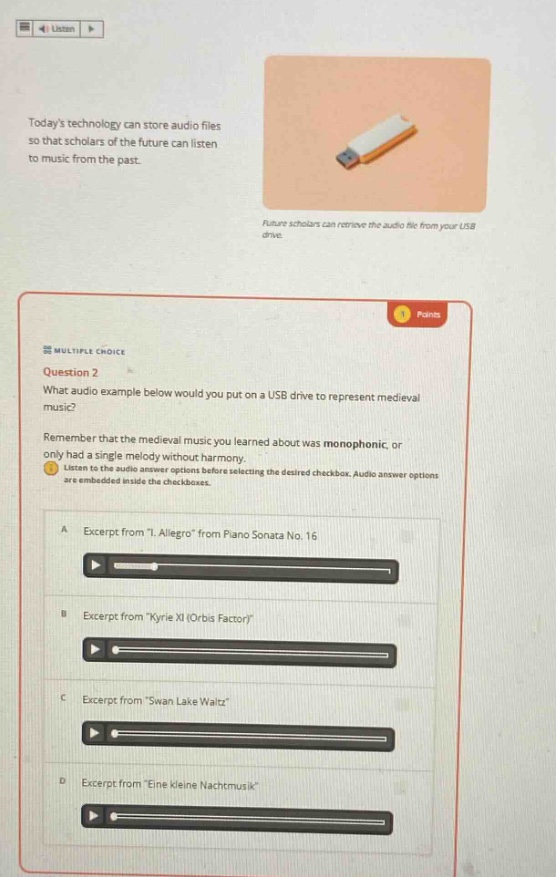
todays technology can store audio files so that scholars of the future can listen to music from the past. future scholars can retrieve the audio file from your usb drive. points multiple choice question 2 what audio example below would you put on a usb drive to represent medieval music? remember that the medieval music you learned about was monophonic, or only had a single melody without harmony. listen to the audio answer options before selecting the desired checkbox. audio answer options are embedded inside the checkboxes. a excerpt from \i. allegro\ from piano sonata no. 16 b excerpt from \kyrie xi (orbis factor)\ c excerpt from \swan lake waltz\ d excerpt from \eine kleine nachtmusik\
Answer
Brief Explanations:
Medieval music was monophonic. "Kyrie XI (Orbis Factor)" is more likely to be a medieval - era piece compared to the others which are from later musical periods. "Allegro" from Piano Sonata No. 16 is Classical, "Swan Lake Waltz" is Romantic, and "Eine kleine Nachtmusik" is Classical.
Answer:
B. Excerpt from "Kyrie XI (Orbis Factor)"