the total area of two square windows is 1,025 in.². each side of the larger window is 5 in. longer than the…
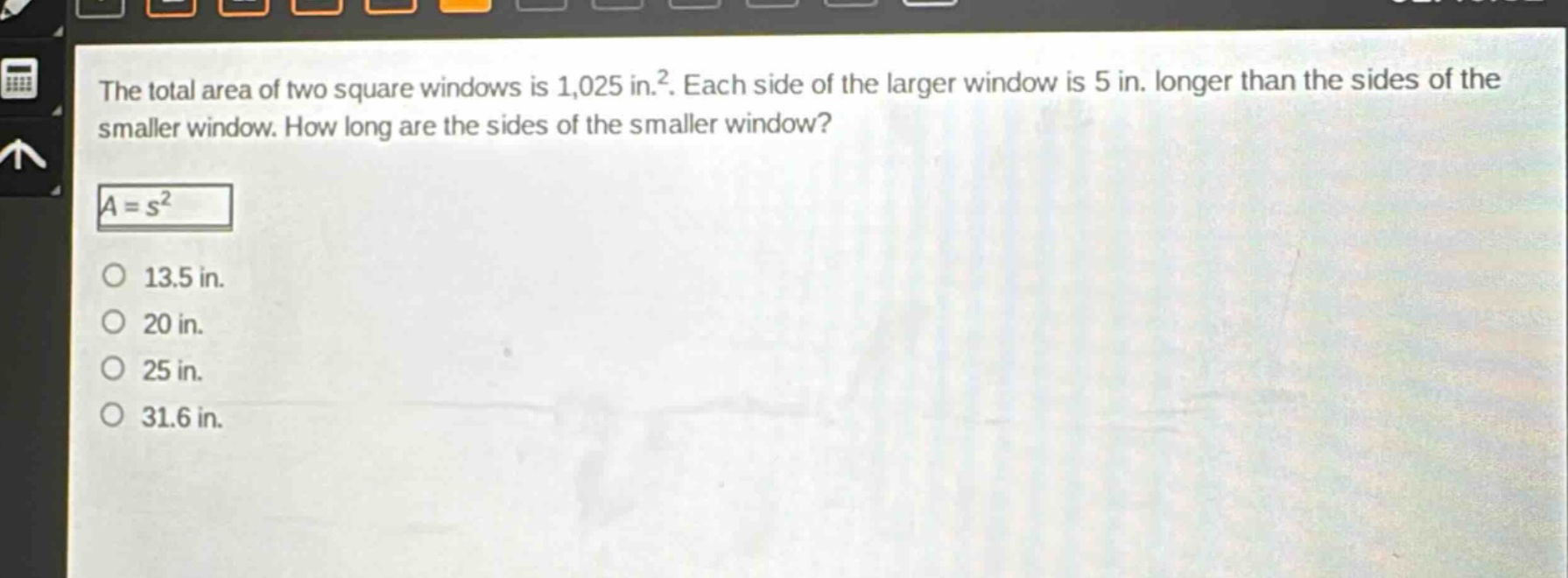
the total area of two square windows is 1,025 in.². each side of the larger window is 5 in. longer than the sides of the smaller window. how long are the sides of the smaller window?\n$a = s^{2}$\n13.5 in.\n20 in.\n25 in.\n31.6 in.
Answer
Answer:
B. 20 in.
Explanation:
Step1: Let side of smaller window be $s$.
Side of larger window is $s + 5$.
Step2: Write area - sum equation.
Area of smaller window is $s^{2}$, area of larger is $(s + 5)^{2}$. Total area is $s^{2}+(s + 5)^{2}=1025$.
Step3: Expand the equation.
$(s + 5)^{2}=s^{2}+10s + 25$, so $s^{2}+s^{2}+10s + 25 = 1025$. Combining like - terms gives $2s^{2}+10s+25 - 1025 = 0$, or $2s^{2}+10s - 1000 = 0$. Dividing by 2 gives $s^{2}+5s - 500 = 0$.
Step4: Solve the quadratic equation.
For a quadratic equation $ax^{2}+bx + c = 0$ ($a = 1$, $b = 5$, $c=-500$), use the quadratic formula $s=\frac{-b\pm\sqrt{b^{2}-4ac}}{2a}$. First, calculate the discriminant $\Delta=b^{2}-4ac=(5)^{2}-4\times1\times(-500)=25 + 2000 = 2025$. Then $s=\frac{-5\pm\sqrt{2025}}{2}=\frac{-5\pm45}{2}$. We have two solutions: $s_1=\frac{-5 + 45}{2}=\frac{40}{2}=20$ and $s_2=\frac{-5 - 45}{2}=\frac{-50}{2}=-25$. Since the side - length cannot be negative, the side of the smaller window is 20 in.