the town librarian bought a combination of new - release movies on dvd for $20 and classic movies on dvd for…
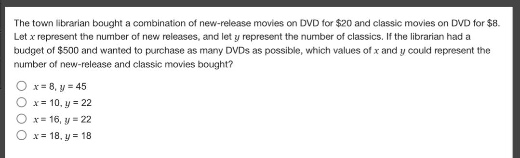
the town librarian bought a combination of new - release movies on dvd for $20 and classic movies on dvd for $8. let $x$ represent the number of new releases, and let $y$ represent the number of classics. if the librarian had a budget of $500 and wanted to purchase as many dvds as possible, which values of $x$ and $y$ could represent the number of new - release and classic movies bought?\n$x = 8,y = 45$\n$x = 10,y = 22$\n$x = 16,y = 22$\n$x = 18,y = 18$
Answer
Answer:
$x = 8,y = 45$
Explanation:
Step1: Set up cost - equation
The cost of new - release movies is $20x$ and the cost of classic movies is $8y$, and the budget is $500$. So the equation is $20x + 8y\leq500$.
Step2: Check option 1
For $x = 8$ and $y = 45$, substitute into the equation: $20\times8+8\times45=160 + 360=520>500$, not valid.
Step3: Check option 2
For $x = 10$ and $y = 22$, substitute: $20\times10+8\times22=200 + 176 = 376$.
Step4: Check option 3
For $x = 16$ and $y = 22$, substitute: $20\times16+8\times22=320+176 = 496$.
Step5: Check option 4
For $x = 18$ and $y = 18$, substitute: $20\times18+8\times18=360 + 144=504>500$, not valid.
Step6: Calculate total number of DVDs
For option 2, the total number of DVDs is $10 + 22=32$. For option 3, the total number of DVDs is $16+22 = 38$. Since $38>32$, the values $x = 16,y = 22$ represent the number of new - release and classic movies bought to maximize the number of DVDs within the budget.