which transformation can be applied to the blue figure to create the red figure?\nreflection across the…
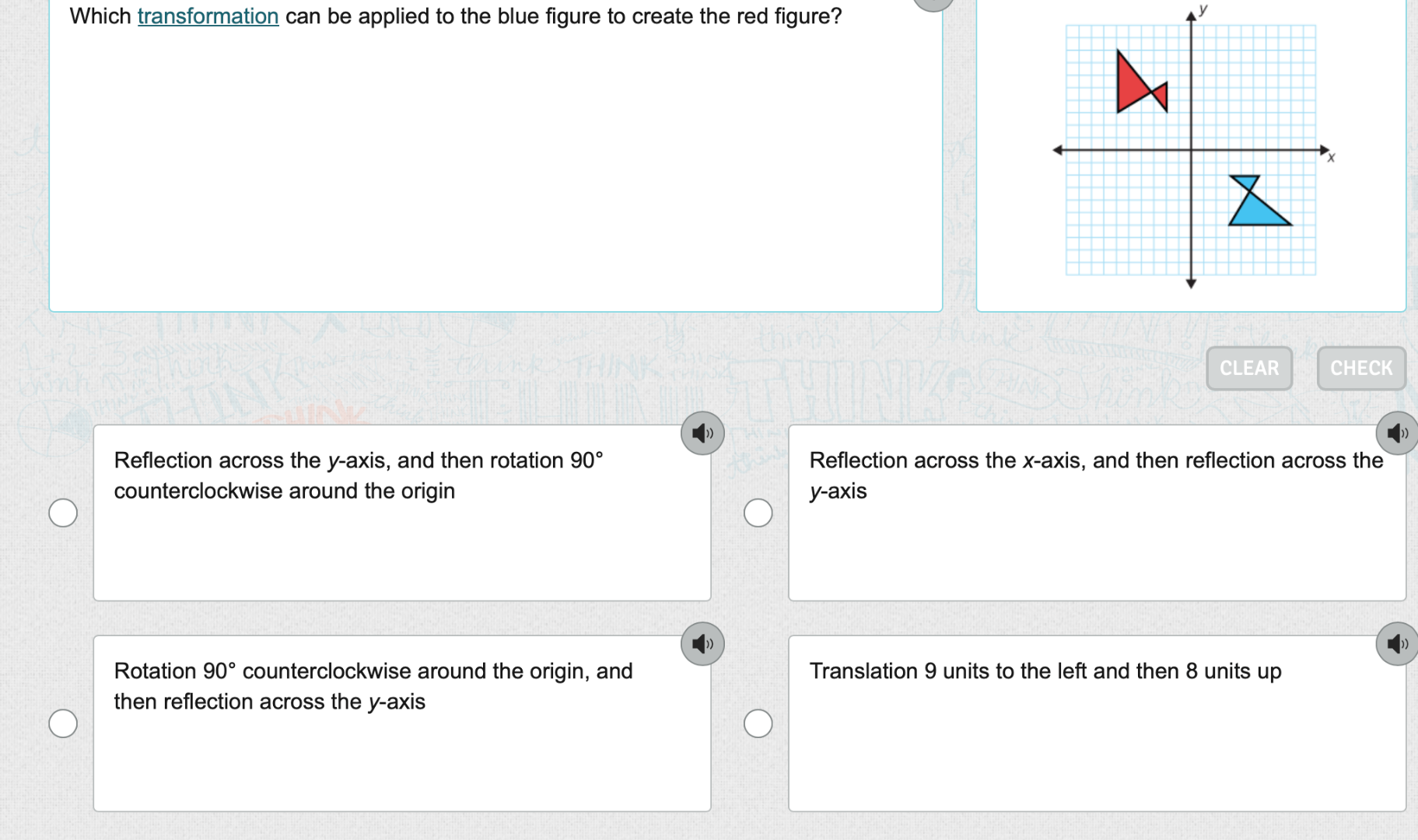
which transformation can be applied to the blue figure to create the red figure?\nreflection across the y-axis, and then rotation 90° counterclockwise around the origin\nreflection across the x-axis, and then reflection across the y-axis\nrotation 90° counterclockwise around the origin, and then reflection across the y-axis\ntranslation 9 units to the left and then 8 units up
Answer
Explanation:
Step1: Identify coordinates of the blue figure
The vertices of the blue figure are $(1, -2)$, $(4, -5)$, and $(2, -5)$.
Step2: Identify coordinates of the red figure
The vertices of the red figure are $(-1, 2)$, $(-4, 5)$, and $(-2, 5)$.
Step3: Determine the coordinate transformation rule
The transformation maps $(x, y)$ to $(-x, -y)$. $$ (1, -2) \rightarrow (-1, 2) $$ $$ (4, -5) \rightarrow (-4, 5) $$ $$ (2, -5) \rightarrow (-2, 5) $$
Step4: Analyze the geometric meaning of the rule
A transformation $(x, y) \rightarrow (-x, -y)$ is equivalent to a reflection across the $x$-axis $(x, -y)$ followed by a reflection across the $y$-axis $(-x, -y)$.
Step5: Verify the chosen option
Reflecting the blue figure across the $x$-axis moves it to the first quadrant. Reflecting that result across the $y$-axis moves it to the second quadrant, matching the red figure.
Answer:
Reflection across the x-axis, and then reflection across the y-axis