which translation maps the graph of the function (f(x)=x^{2}) onto the function (g(x)=x^{2}+2x + 6)?\nleft 1…
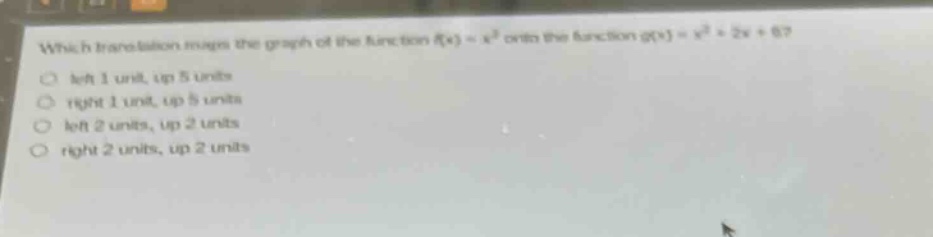
which translation maps the graph of the function (f(x)=x^{2}) onto the function (g(x)=x^{2}+2x + 6)?\nleft 1 unit, up 5 units\nright 1 unit, up 5 units\nleft 2 units, up 2 units\nright 2 units, up 2 units
Answer
Explanation:
Step1: Rewrite $g(x)$ in vertex - form
We complete the square for $g(x)=x^{2}+2x + 6$. [ \begin{align*} g(x)&=x^{2}+2x+6\ &=(x^{2}+2x + 1)-1 + 6\ &=(x + 1)^{2}+5 \end{align*} ] The vertex - form of a quadratic function is $y=a(x - h)^{2}+k$, where $(h,k)$ is the vertex of the parabola. For $f(x)=x^{2}$, the vertex is $(0,0)$, and for $g(x)=(x + 1)^{2}+5$, the vertex is $(-1,5)$.
Step2: Determine the translation
The general rule for a translation of a function $y = f(x)$ to $y=f(x - h)+k$ is a horizontal translation of $h$ units and a vertical translation of $k$ units. If $h>0$, the graph moves to the right; if $h < 0$, the graph moves to the left. If $k>0$, the graph moves up; if $k < 0$, the graph moves down. For the transition from $y = x^{2}$ to $y=(x + 1)^{2}+5$, we have $h=-1$ and $k = 5$. So the graph of $y=x^{2}$ is translated 1 unit to the left and 5 units up.
Answer:
left 1 unit, up 5 units