can a translation and a reflection map △qrs to △tuv? explain why or why not.\nno, the triangles are not…
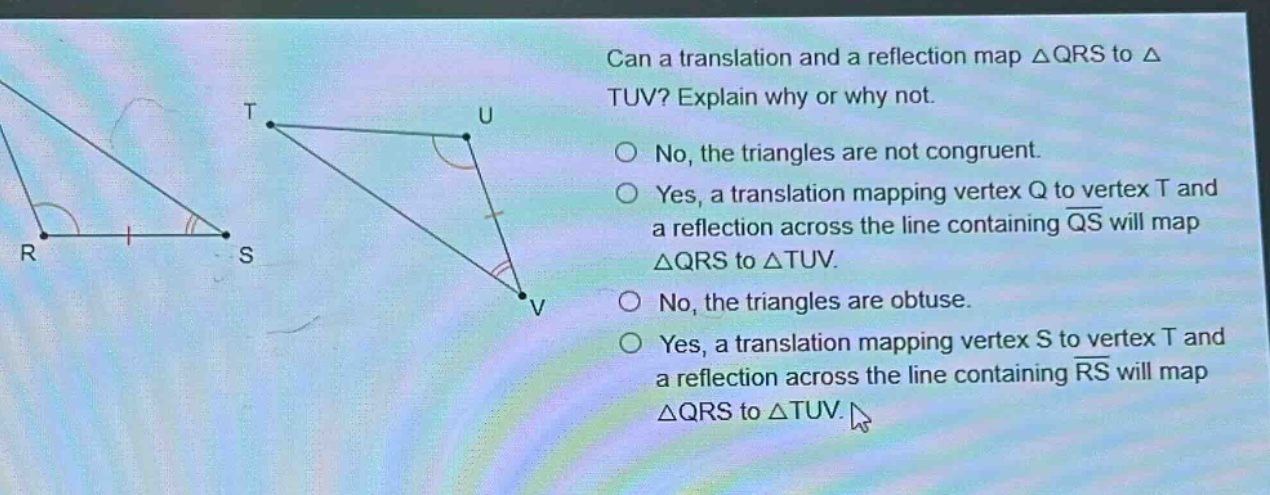
can a translation and a reflection map △qrs to △tuv? explain why or why not.\nno, the triangles are not congruent.\nyes, a translation mapping vertex q to vertex t and a reflection across the line containing qs will map △qrs to △tuv.\nno, the triangles are obtuse.\nyes, a translation mapping vertex s to vertex t and a reflection across the line containing rs will map △qrs to △tuv.
Answer
Explanation:
Step1: Recall congruence and rigid - motions
Rigid - motions (translation, reflection, rotation) preserve congruence. If two triangles are congruent, we can map one to the other using rigid - motions.
Step2: Check triangle congruence
By observing the markings on the triangles (equal angles and equal sides), we can see that $\triangle QRS\cong\triangle TUV$.
Step3: Analyze the rigid - motion sequence
A translation that maps vertex $Q$ to vertex $T$ and then a reflection across the line containing $\overline{QS}$ will map $\triangle QRS$ to $\triangle TUV$.
Answer:
Yes, a translation mapping vertex Q to vertex T and a reflection across the line containing $\overline{QS}$ will map $\triangle QRS$ to $\triangle TUV$.