how can a translation and a reflection be used to map △hjk to △lmn? translate k to n and reflect across the…
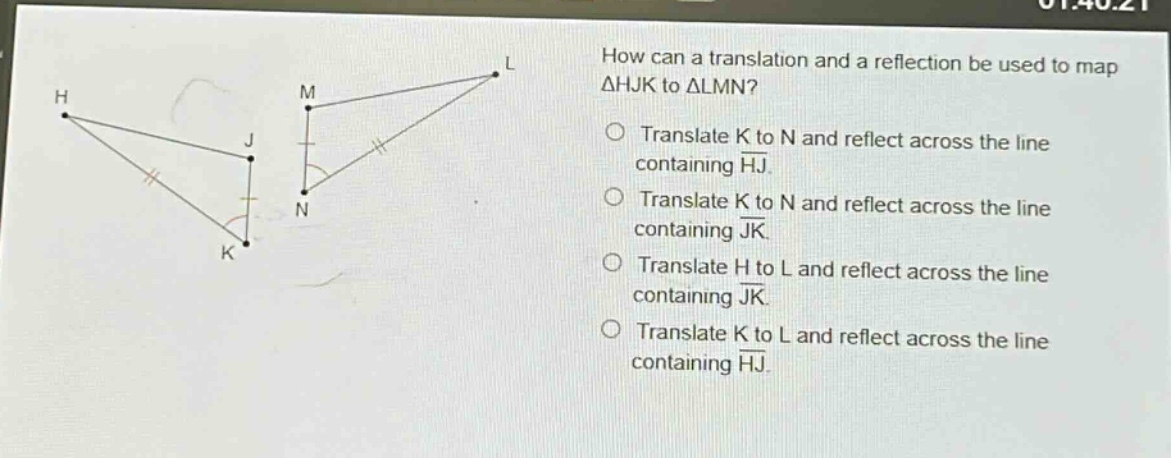
how can a translation and a reflection be used to map △hjk to △lmn? translate k to n and reflect across the line containing $overline{hj}$. translate k to n and reflect across the line containing $overline{jk}$. translate h to l and reflect across the line containing $overline{jk}$. translate k to l and reflect across the line containing $overline{hj}$.
Answer
Answer:
Translate H to L and reflect across the line containing $\overline{JK}$.
Explanation:
Step1: Analyze translation
To map $\triangle HJK$ to $\triangle LMN$, we first need to match one - to - one corresponding vertices. Translating a key vertex helps in aligning the triangles initially. Translating vertex H to vertex L moves $\triangle HJK$ closer to the position of $\triangle LMN$.
Step2: Analyze reflection
After translating H to L, reflecting across the line containing $\overline{JK}$ will map the remaining vertices of $\triangle HJK$ to the corresponding vertices of $\triangle LMN$. This combination of translation and reflection will correctly map $\triangle HJK$ to $\triangle LMN$.