how can a translation and a rotation be used to map △hjk to △lmn?\ntranslate h to l and rotate about h until…
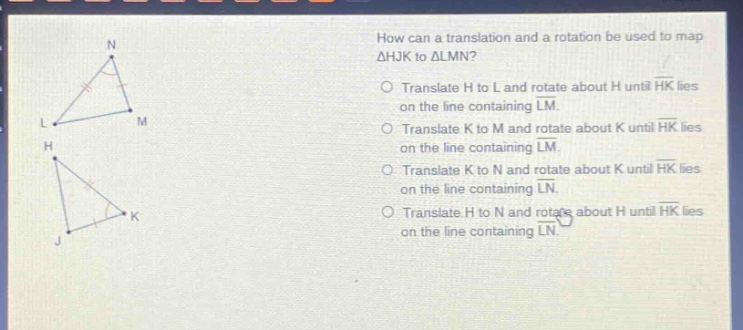
how can a translation and a rotation be used to map △hjk to △lmn?\ntranslate h to l and rotate about h until hk lies on the line containing lm.\ntranslate k to m and rotate about k until hk lies on the line containing lm.\ntranslate k to n and rotate about k until hk lies on the line containing ln.\ntranslate h to n and rotate about h until hk lies on the line containing ln.
Answer
Explanation:
Step1: Analyze translation
To map $\triangle HJK$ to $\triangle LMN$, we first need to translate a corresponding vertex. The correct vertex - to - vertex translation is to move a vertex of $\triangle HJK$ to the corresponding vertex of $\triangle LMN$. We want to map point $H$ to point $L$ first.
Step2: Analyze rotation
After translating $H$ to $L$, we need to rotate the triangle about point $H$ (now at the position of $L$) so that one of the sides of $\triangle HJK$ aligns with the corresponding side of $\triangle LMN$. We should rotate about $H$ until $HK$ lies on the line containing $LM$.
Answer:
Translate $H$ to $L$ and rotate about $H$ until $HK$ lies on the line containing $LM$.