is trapezoid abdc the result of a dilation of trapezoid mnpq by a scale factor of $\frac{2}{5}$? why or why…
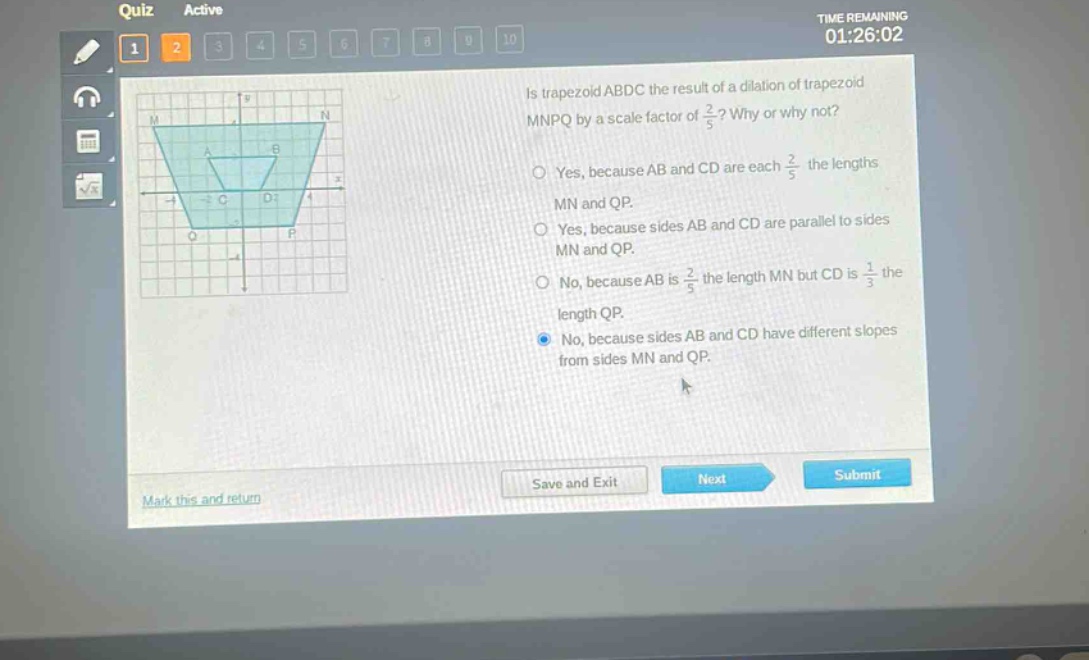
is trapezoid abdc the result of a dilation of trapezoid mnpq by a scale factor of $\frac{2}{5}$? why or why not?\nyes, because ab and cd are each $\frac{2}{5}$ the lengths mn and qp.\nyes, because sides ab and cd are parallel to sides mn and qp.\nno, because ab is $\frac{2}{5}$ the length mn but cd is $\frac{1}{3}$ the length qp.\nno, because sides ab and cd have different slopes from sides mn and qp.
Answer
Explanation:
Step1: Recall dilation property
In a dilation, corresponding sides are parallel and the ratio of corresponding - side lengths is equal to the scale factor.
Step2: Analyze the given trapezoids
For a dilation of trapezoid MNPQ to trapezoid ABDC by a scale factor of $\frac{2}{5}$, all corresponding sides should be in the ratio $\frac{2}{5}$ and be parallel. Just having some side - length ratios correct (as in the first two incorrect options) is not enough. The third option has inconsistent side - length ratios. The fourth option is correct because if sides AB and CD have different slopes from sides MN and QP, they are not parallel, and thus trapezoid ABDC is not a dilation of trapezoid MNPQ by a scale factor of $\frac{2}{5}$.
Answer:
No, because sides AB and CD have different slopes from sides MN and QP.